The Girl Who Wanted to See North
The warbler weighed less than two nickels, but it had just crossed Lake Erie in the dark.
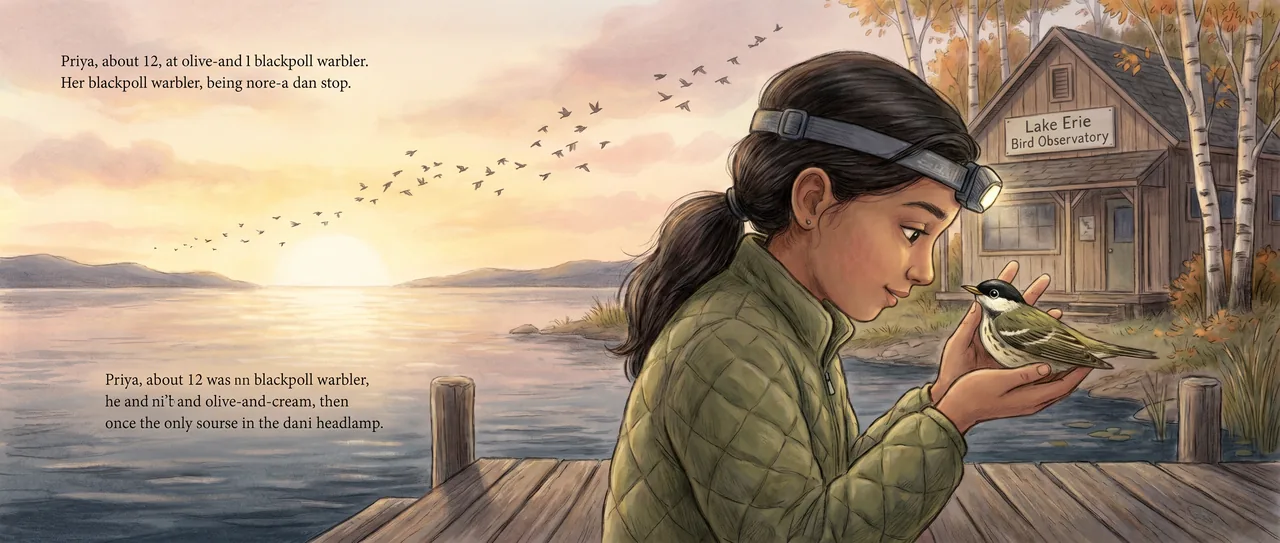
Priya held it the way Dr. Barros had taught her — gently cradled, two fingers forming a V around its neck so it couldn't turn and bite. Not that a bird this small could do much damage. It was a blackpoll warbler, and in three weeks it would be in South America.
"Band number?" Dr. Barros called from the folding table.
"K-7741," Priya read off the tiny aluminum ring. She wrote the number in the logbook, then added her own note in the margin: *Arrived 5:47 a.m. Wind NNW. How does it know where to go?*
She'd been writing questions in the margins all week. The logbook was supposed to be for numbers only. Dr. Barros hadn't said anything about it, but Priya noticed him reading her notes when he thought she wasn't looking.
She released the warbler and watched it vanish into the birch trees like a thrown stone that changed its mind about falling.
That afternoon, while the other junior volunteers played cards in the bunkhouse, Priya sat on the dock with her legs dangling over the gray water and reread the question she couldn't stop asking. Not the big one — not *how does it navigate* — but a smaller, stranger one that lived inside it.
She'd read that birds could sense Earth's magnetic field. Fine. Lots of animals did that. But the book she'd found in the station's little library said something she couldn't stop turning over in her mind: the birds didn't just *sense* the field. They *saw* it.
There was a protein in their eyes — cryptochrome, the book called it — and when light hit it, something happened at the level of individual electrons. Quantum something. The electrons existed in two states at once, and the magnetic field tipped the balance between those states, and that tipping changed what the bird's eye reported to its brain.
Which meant the magnetic field wasn't invisible to them. It was *right there*, laid over the world like a second sky.
Priya pulled her knees up and pressed her chin against them. She stared south across the lake and tried to imagine it: a wash of color — or light, or shadow, she didn't know — that pooled toward magnetic north. A gradient painted across everything. Trees, clouds, waves, all wearing a direction you could see as plainly as you could see that the sky was blue.
She closed her eyes and tried to feel it. Nothing happened, of course. She didn't have cryptochrome doing quantum tricks in her retinas.
But the warbler did.
That night at dinner, she asked Dr. Barros the margin question out loud.
"If cryptochrome works because of quantum effects in single electrons, and quantum effects are — I mean, they're incredibly tiny and fragile — how does a *bird* keep that process stable enough to navigate thousands of miles?"
The other volunteers looked at their soup. Priya felt the familiar heat in her cheeks — the feeling of having asked too much, too specifically, in a room that wanted smaller questions.
But Dr. Barros set down his spoon.
"That," he said, "is exactly the question the entire field is trying to answer. Nobody knows yet. The quantum coherence in cryptochrome lasts longer than it has any right to. Some researchers think biology found a trick that physicists haven't figured out how to copy."
Priya's spoon stopped halfway to her mouth.
"Wait. The *bird* is doing quantum mechanics better than our *labs*?"
Dr. Barros smiled the way adults smile when a kid has walked to the edge of something real. "The bird, the European robin, the garden warbler — yes. Life seems to have solved a quantum engineering problem, inside a cell, at body temperature, millions of years before we even knew quantum mechanics existed."
Priya set the spoon down. The cafeteria felt larger. Not the room — the *everything*. Because if a ten-gram bird carried in its eye a quantum system more stable than anything human engineers had built, then every blackpoll warbler she'd banded that week was a flying laboratory, and the sky they moved through was not the empty blue she'd always assumed but something richer, painted with information she had no sense organ to detect.
And if biology had solved that problem once — with one protein, in one eye, in one lineage of dinosaurs that learned to fly — what else had life quietly figured out that no one had thought to ask about yet?
She barely slept. At four-thirty in the morning she was already at the mist nets, headlamp on, waiting.
The first bird of the day was another blackpoll warbler. Maybe even the same one — K-7741, back for an encore. She held it gently, felt its heartbeat drumming against her fingers like a tiny engine running hot.
She looked into its eye.
It was dark, round, and impossibly clear — a bead of living glass tuned to wavelengths she would never see. Somewhere in that eye, right now, electrons were doing things that Einstein had argued with Bohr about, and the bird was using the result to draw a map home across an ocean.
She banded it. Logged it. Added a margin note: *What other quantum tricks is biology hiding? Check: photosynthesis? Enzyme tunneling? Smell?*
She released the warbler. It flew south over the lake, following a compass made of light and quantum whispers and the whole magnetic soul of the spinning Earth.
Priya watched it go. She did not have cryptochrome in her eyes.
But she had something else — something that could look at a bird and ask *how*, then ask *why*, then ask *what if*.
And as the sun came up over Lake Erie and the sky filled with ten thousand tiny navigators carrying quantum secrets in their skulls, Priya picked up the logbook, opened it to a fresh page, and began writing down every question she did not yet know how to answer.
Read the interactive version, listen to the narration, and earn a gold star →
A science-verified short story for curious kids · Curiosity Land