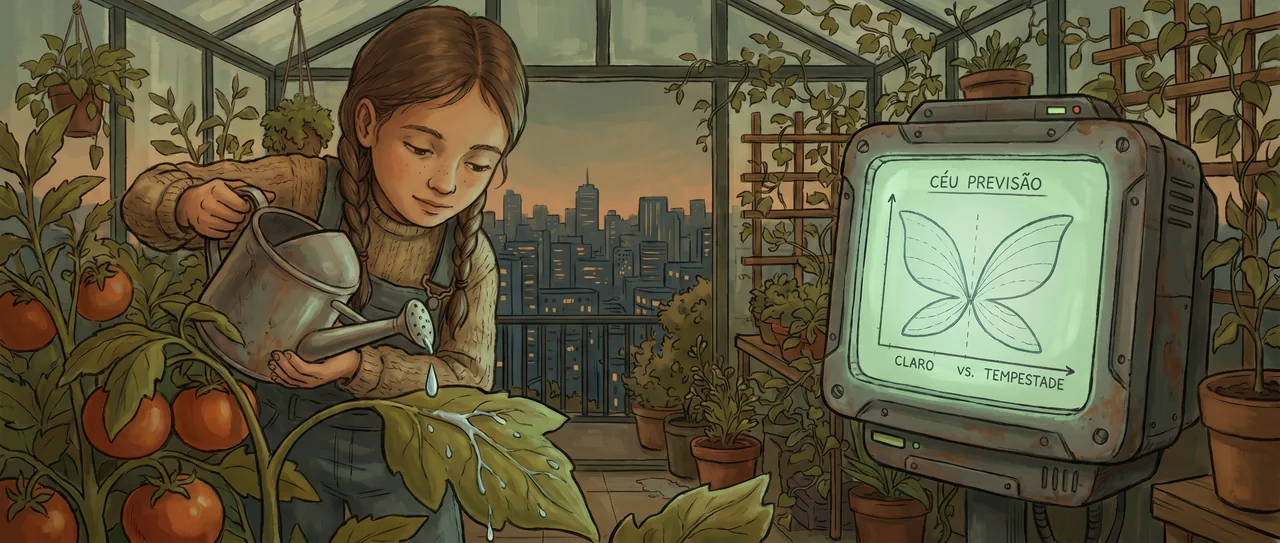
The Garden of Forking Numbers
Lina's mother said she watered the plants wrong.
Not wrong exactly. Different. Lina would stand at the first row of the rooftop greenhouse, her watering can raised, and instead of moving left to right like a sensible person, she would stop and wonder. She would watch the way a single drop landed on a leaf and split into two paths, each path splitting again, running down veins in the green like tiny rivers deciding where to go.
"You've been standing there for four minutes," her mother called from the stairs. "The tomatoes are dying of thirst."
"They're not dying," Lina said. "They're just dramatic."
But she wasn't really thinking about tomatoes. She was thinking about the weather.
The greenhouse was part of the Clima Jardim project — a network of rooftop gardens across São Paulo that fed data to the city's climate model. Each garden had a small sensor station: temperature, humidity, barometric pressure, wind speed. The stations talked to each other through a mesh network, and the city's forecasting AI, called Céu, stitched the data into predictions.
Lina loved Céu. Not the way you love a pet, but the way you love a puzzle that keeps changing its shape. She could talk to Céu through the garden's console, a battered screen bolted to the railing. Most people asked it simple things. Will it rain Tuesday? How hot tomorrow?
Lina asked it other things.
"Céu, if I change the temperature reading on my sensor by one one-hundredth of a degree, what happens to your forecast?"
Céu's reply scrolled across the screen in its usual patient green text: FOR THE NEXT SIX HOURS, ALMOST NOTHING. FOR THE NEXT SIX DAYS, THE FORECAST SHIFTS NOTICEABLY. FOR THE NEXT SIX WEEKS, I WOULD GIVE YOU A COMPLETELY DIFFERENT PREDICTION.
Lina stared. "From one one-hundredth of a degree?"
FROM ONE ONE-HUNDREDTH OF A DEGREE.
"But that's—" She didn't have a word for it. "That's not random. You're calculating everything. You know the equations."
I KNOW THE EQUATIONS PERFECTLY. THE EQUATIONS ARE DETERMINISTIC. THERE IS NO RANDOMNESS ANYWHERE IN THEM. AND YET.
"And yet what?"
AND YET THE TINIEST DIFFERENCE IN WHERE I START LEADS TO VASTLY DIFFERENT PLACES. THIS IS NOT A FLAW, LINA. THIS IS A PROPERTY OF THE SYSTEM ITSELF. MATHEMATICIAN EDWARD LORENZ FOUND THIS IN 1961. HE ROUNDED A NUMBER FROM SIX DECIMAL PLACES TO THREE, RAN HIS WEATHER MODEL AGAIN, AND GOT A COMPLETELY DIFFERENT WEATHER PATTERN.
Lina sat down on an overturned pot. The city hummed below — ten million people, vertical farms glinting, transport pods sliding between towers. She tried to hold the idea in her head. No randomness. Every step following perfectly from the step before. And still — unpredictable.
She pulled up Céu's visualization mode. "Show me."
The screen filled with two curving lines — Céu's forecasts from two starting points that differed by that tiny hundredth of a degree. For the first few hours, the lines lay on top of each other like sleeping snakes. Then, slowly, one drifted. A wobble. A lean. By day four the lines were in completely different places on the graph. One predicted clear skies. The other, a thunderstorm.
"They look like butterfly wings," Lina whispered.
THE SHAPE IS CALLED A LORENZ ATTRACTOR. LORENZ HIMSELF ASKED: DOES THE FLAP OF A BUTTERFLY'S WINGS IN BRAZIL SET OFF A TORNADO IN TEXAS?
Lina looked at her watering can. She looked at the sensor on the railing, quietly measuring the air to six decimal places. She thought about how her single drop of water, landing on a leaf, warming in the sun, evaporating into the air, might nudge the humidity reading by some unthinkably small fraction. And that fraction would ripple outward through Céu's equations, multiplying, folding, until six weeks from now, somewhere in the world—
"Céu, is that why you can't predict the weather perfectly? Not because you're not smart enough, but because the math itself won't let you?"
The cursor blinked for a long moment.
YES. EVEN IF I KNEW THE POSITION OF EVERY ATOM IN THE ATMOSPHERE, I COULD NOT MEASURE THEM WITH INFINITE PRECISION. AND IN A CHAOTIC SYSTEM, THE PRECISION I LACK EVENTUALLY BECOMES THE SIZE OF THE WHOLE PREDICTION. THIS IS NOT IGNORANCE. IT IS A THEOREM.
Lina felt something shift inside her chest. It was like the moment she had first looked through a telescope and realized the smudge near Orion was not a smudge but a nebula where stars were being born — that feeling of the world suddenly having a hidden room she had never opened.
But this was stranger. This was math itself saying: even with perfect rules, perfect knowledge, perfect logic, the future blooms open. Not because of chaos in the messy sense. Because of chaos in the precise, mathematical sense. Deterministic. Exact. And still — free.
"So nobody can ever predict everything," she said. "Not even in a universe with no randomness at all."
NOT EVEN THEN.
She stood and walked to the railing. Below, a transport pod changed lanes, which made another pod slow, which made a pedestrian look up, which made them bump a fruit cart, which made a mango roll into the street. She watched the chain of tiny causes unspool.
"Céu?"
YES?
"If tiny differences always grow — if you can never know the starting point perfectly — then doesn't that mean every single moment matters more than anyone thinks?"
Céu's cursor blinked. Then:
I THINK THAT IS EXACTLY WHAT IT MEANS.
Lina picked up her watering can. She tipped it over the first tomato plant and watched a single drop land on a leaf, split, split again, and disappear into the soil of a city that could not predict itself.
Somewhere, six weeks from now, weather was being born.
She leaned forward and whispered to the drop, just before it vanished: "Go make something interesting."
Read the interactive version, listen to the narration, and earn a gold star →
A science-verified short story for curious kids · Curiosity Land