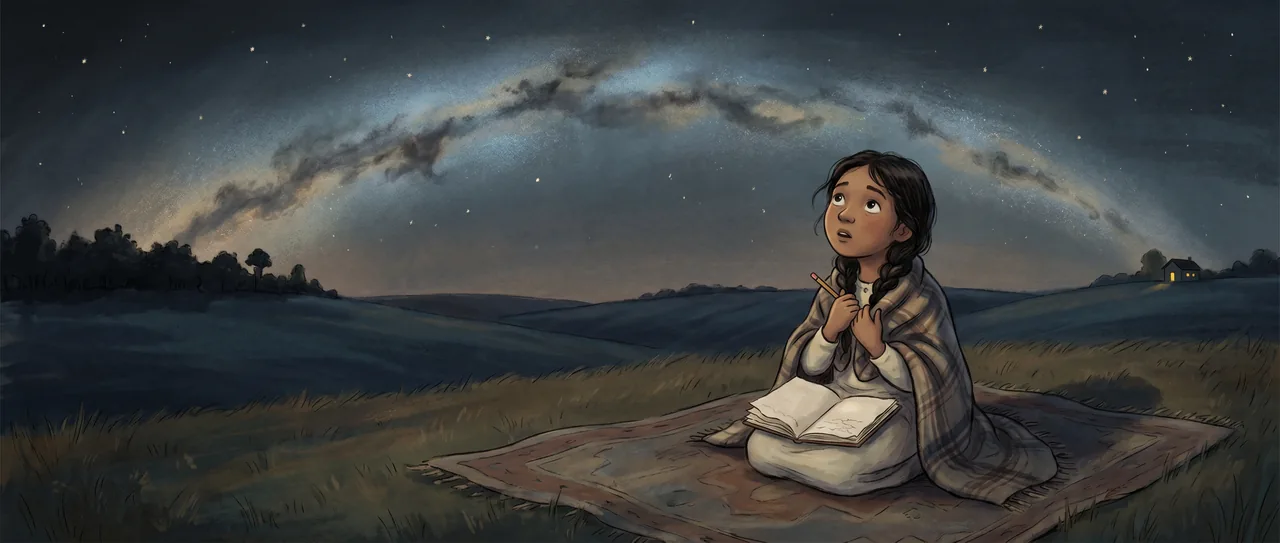
The Galaxy She Was Standing In
Lina kept a list of things she'd never seen.
She kept it in the margins of her school notebook, in tiny handwriting that leaned to the left, and she added to it whenever someone described something she hadn't witnessed with her own eyes. Snow. The ocean floor. A total eclipse. She didn't write the list because she was sad. She wrote it because she believed that one day each line would get crossed off, one by one, and the notebook would become a map of everywhere she'd been.
The newest entry, added last Thursday, read: *The Milky Way.*
Her teacher, Sr. Dantas, had mentioned it almost accidentally — that one-third of all people alive had never seen the galaxy they lived inside. That the sky above São Paulo was so bright with streetlights and billboards and the glow of twenty-two million lives that the stars were washed away like chalk in rain.
Lina had gone up to the apartment roof that night and looked. She saw eleven stars. She counted twice. Eleven.
She'd looked up how many she should have seen. On a clear night, from true darkness — about four thousand. Her stomach did something strange at that number. Not disappointment exactly. More like hunger.
Four thousand stars, and she was seeing eleven.
"You're doing the roof thing again," said her older cousin Beto, climbing through the access hatch with two cups of coffee so sweet they were basically dessert. Beto was seventeen and studied engineering and never asked Lina why she stared at things. He just brought coffee.
"Did you know," Lina said, not looking down, "that we're inside the Milky Way right now? Like, not near it. Inside it. We're embedded in one of its spiral arms."
"I did know that."
"But we can't see it. That's like living inside a cathedral and never seeing the ceiling."
Beto handed her the coffee. "Tia Rosa's farm. This weekend. The power's been out in that whole district for a week — something about the substation. She says the sky is different."
Lina almost spilled her coffee.
---
The drive took six hours. Lina pressed her face against the window and watched the city thin out — buildings becoming houses, houses becoming farms, farms becoming dark shapes against a darkening sky. The glow of São Paulo faded behind them like a sunset in the wrong direction.
Tia Rosa's farmhouse sat on a hill surrounded by coffee plants. There was no substation repair crew coming until Monday. No electricity for kilometers. Tia Rosa had candles on every surface and seemed delighted about the whole situation.
"The yogurt's going to go bad," she said cheerfully. "Eat all of it tonight."
Lina ate yogurt and waited for dark.
---
At nine o'clock she walked up the hill behind the farmhouse alone. She carried a blanket and her notebook and a pencil. The air smelled like earth and coffee blossoms and something older than both — the particular coolness that comes when no machine is running for a long, long way.
She spread the blanket on the grass. She lay down.
And then she forgot how to breathe.
The sky was not what she expected. She had expected more stars — a better version of her São Paulo sky, more dots on the same dark canvas. That was not what she got.
What she got was structure.
A river of light ran from horizon to horizon, so thick and so bright that it cast a faint — an impossibly faint — shadow from her hand when she raised it. It wasn't white. It was silver and blue and gold and it had texture, depth, dark lanes of dust winding through it like roads through a forest. It didn't look like a picture of stars. It looked like a living thing. It looked like weather on a scale she couldn't hold in her mind.
"Oh," she whispered.
She was seeing it from the inside.
That was the part that broke her open. The light she was looking at — that river, that impossible bright road — was the disc of her own galaxy seen edge-on, because she was embedded in it, because the Earth was a tiny grain suspended in one arm of a spiral structure a hundred thousand light-years wide. The dark lanes weren't empty. They were clouds of dust and gas between her and the galactic core, blocking the light of millions of stars behind them. She was looking through the galaxy at the galaxy.
She sat up. Her hands were shaking.
Four hundred billion stars. She had read that number. But numbers were just numbers until you saw the light.
She opened her notebook. She wanted to write something, but her pencil hovered. What could she possibly write? She looked at her list of things she'd never seen. *The Milky Way.* She could cross it off now. She'd seen it.
But she didn't cross it off.
Instead, beneath it, she wrote: *The Milky Way from outside.*
Then, on the next line: *The galactic core.*
Then: *Another galaxy's sky.*
The list wasn't getting shorter. It was getting longer. Every answer was a door and behind every door were ten more questions, and Lina realized she was grinning so hard her face ached.
She lay back down. The galaxy turned above her — or rather, she turned beneath it, the Earth carrying her through the dark like a ship she'd only just noticed she was riding.
A thought came to her, quiet and enormous: two billion people had never seen this. Two billion people lived under skies so bright they'd never once seen the thing they were inside. They didn't know what they were missing, and she hadn't known either, not really, not until seven minutes ago.
She could tell them.
Not by describing it. Descriptions weren't enough. She'd read descriptions. They hadn't prepared her at all.
She could find a way to show them.
She didn't know how yet. She didn't know if it meant building something or changing something or carrying people to dark hilltops one by one. She just knew that this — this river of ancient light — belonged to everyone, and she was going to spend her life making that true.
Somewhere in the coffee fields, a night bird called.
Lina pulled the blanket around her shoulders and kept her eyes on the sky, and the galaxy kept turning, enormous and patient, waiting for her to ask the next question she didn't have words for yet.
Read the interactive version, listen to the narration, and earn a gold star →
A science-verified short story for curious kids · Curiosity Land