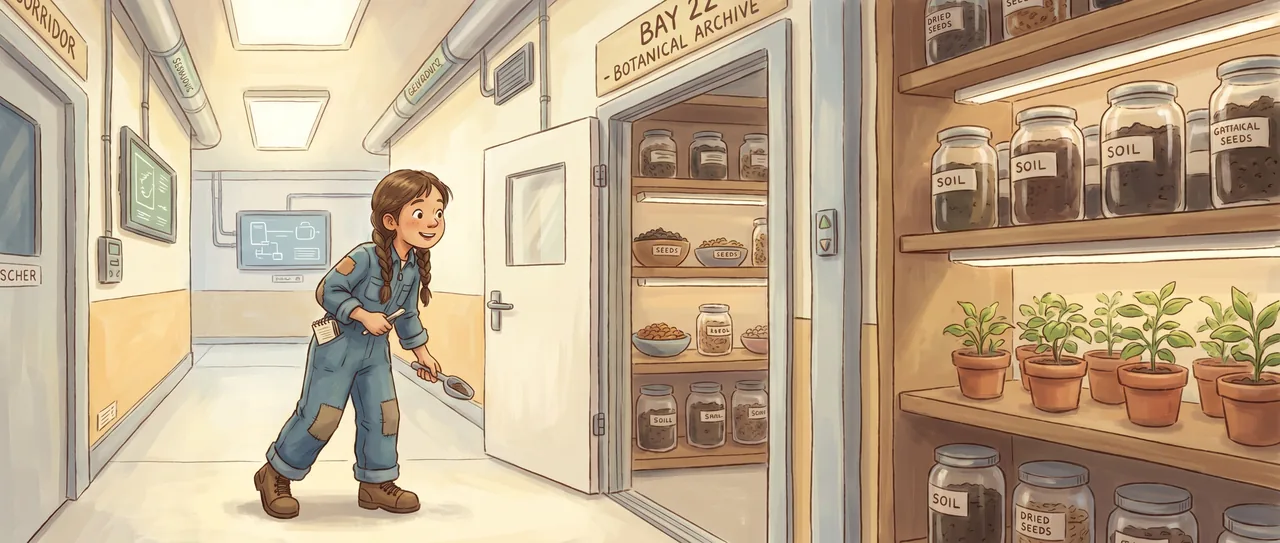
The Backup Garden
The first thing Mara noticed was that the tomatoes in Bay 7 were dying.
Not the dramatic kind of dying — no wilting, no brown spots, no obvious catastrophe. Just a subtle wrongness. The leaves were a shade too pale. The stems reached for the grow-lights at angles that seemed tired. Mara pressed her thumb against the soil and brought it to her nose, the way her grandmother had taught her before Nana went into long-sleep for the final leg of the voyage.
"Smells empty," Mara murmured.
Kai, who was supposed to be her partner for Agricultural Rotation but mostly just ate the strawberries, looked up from his tablet. "Soil doesn't smell like anything."
"Healthy soil smells like rain and bread and something electric. This smells like dust."
Kai shrugged. Mara wrote it down in the small notebook she kept in her back pocket — the one the other kids called her "weird diary." It wasn't a diary. It was a collection of things that didn't match.
By Thursday, Bays 4 through 12 were failing. The ship's agricultural AI, Perseph, ran diagnostics and confirmed what every adult on the agri-team already feared: the bacterial cultures in the main soil beds had crashed. Some interaction between the new nutrient cycling protocol and a solar radiation event had wiped out the microbial colonies that made the soil alive.
Mara sat in the observation corridor above the biodome and listened to the adults argue through the ventilation grate.
"We can reintroduce from the frozen cultures—"
"The frozen stock was compromised in the same radiation event. The backup freezer's seal failed."
"Then we grow from what's left. There must be surviving colonies—"
"Not enough. Not nearly enough. The diversity is gone."
Mara's chest tightened. She understood what they weren't saying. The generation ship *Amaranth* was eleven years into a forty-year voyage. The biodome wasn't decoration. It was their food. It was their air.
That night, she couldn't sleep. She lay in her bunk reading her grandmother's old biology texts on her tablet — the ones Nana had uploaded before long-sleep, the ones no one else ever borrowed from the ship's library. Mara read the way some kids ran: hard, fast, and because something in her needed it.
She stopped on a page about the human appendix.
For a long time, the text said, people thought the appendix was useless — a leftover from evolution, like a room in a house no one enters. But it wasn't useless at all. The appendix was a sanctuary. A hidden garden. When illness swept through the gut and destroyed the bacterial colonies that kept a person healthy, the appendix — tucked away, protected, overlooked — still held a reserve of those good bacteria. After the storm passed, they crept back out and reseeded the intestine. The body had built its own backup system, and no one had noticed for centuries because they weren't paying attention.
Mara sat up so fast she hit her head on the upper bunk.
She grabbed her notebook and flipped to a page from six months ago. She'd written: *Bay 22 — sealed off after coolant leak. Soil still inside. No one bothered to remove it. Door welded shut but ventilation gap at top — too small for people, not too small for air.*
Bay 22. Sealed before the new nutrient protocol. Sealed before the radiation event.
A closed room that no one had thought about since.
Mara was already pulling on her shoes.
The corridor to Bay 22 was dim and cool. The welded door was exactly as she remembered — sealed tight, but with a narrow ventilation gap near the ceiling where a panel had been removed and never replaced. Mara climbed a maintenance ladder, squeezed her arm through with a sample scoop she'd taken from the lab, and stretched until her shoulder ached.
She couldn't see inside. She could only reach.
The scoop came back full of dark, crumbly soil. She held it under her nose.
Rain. Bread. Something electric.
"Oh," she whispered, and her eyes burned. "You're alive in there."
She brought the sample to Perseph's analysis bay herself, at two in the morning, and asked the AI to run a microbial diversity scan.
Perseph's voice was warm and unhurried, the way it always was. "Mara, this sample contains over three hundred identified bacterial strains. This is... this is remarkable. Where did you find this?"
"Bay 22. The one everyone forgot."
The AI was quiet for two full seconds, which for Perseph was a very long time. "This is sufficient to recolonize the main beds. More than sufficient. Mara, do you understand what you've found?"
Mara looked at the soil in her hand — dark, ordinary, teeming with invisible life. "The ship grew its own appendix," she said. "We just didn't know it."
By morning the agri-team had cut open Bay 22 and begun the transfer. Within a week, the first beds were darkening again, filling with the microbial webs that turned dead dirt into something that could sustain life. The tomatoes in Bay 7 straightened. Mara checked them every day, pressing her thumb into the soil, breathing in.
Kai found her there on the eighth day. He stood awkwardly for a moment, then sat down beside her.
"How did you know?" he asked.
"I read something. And I noticed something. And they fit together."
"Yeah, but how did you *know* to notice?"
Mara thought about that. She thought about her notebook full of things that didn't match, and the way people sometimes looked at her when she smelled the soil or counted the angle of leaves or asked questions that made everyone go quiet.
"I don't know," she said honestly. "I just can't stop paying attention. My brain won't let me not."
Kai nodded slowly. Then he pulled out his tablet, opened the ship library, and searched: *human appendix, bacterial reservoir*.
Mara watched him read.
Above them, the grow-lights hummed. In the soil beneath their hands, three hundred species of bacteria were quietly, invisibly spreading through the dark — rebuilding a world from a room everyone had forgotten, doing what life does when you give it the smallest chance.
And somewhere in the back of Mara's mind, a new question was already forming — one she didn't have words for yet — about what other forgotten, overlooked, supposedly useless things might be quietly saving everything.
Read the interactive version, listen to the narration, and earn a gold star →
A science-verified short story for curious kids · Curiosity Land