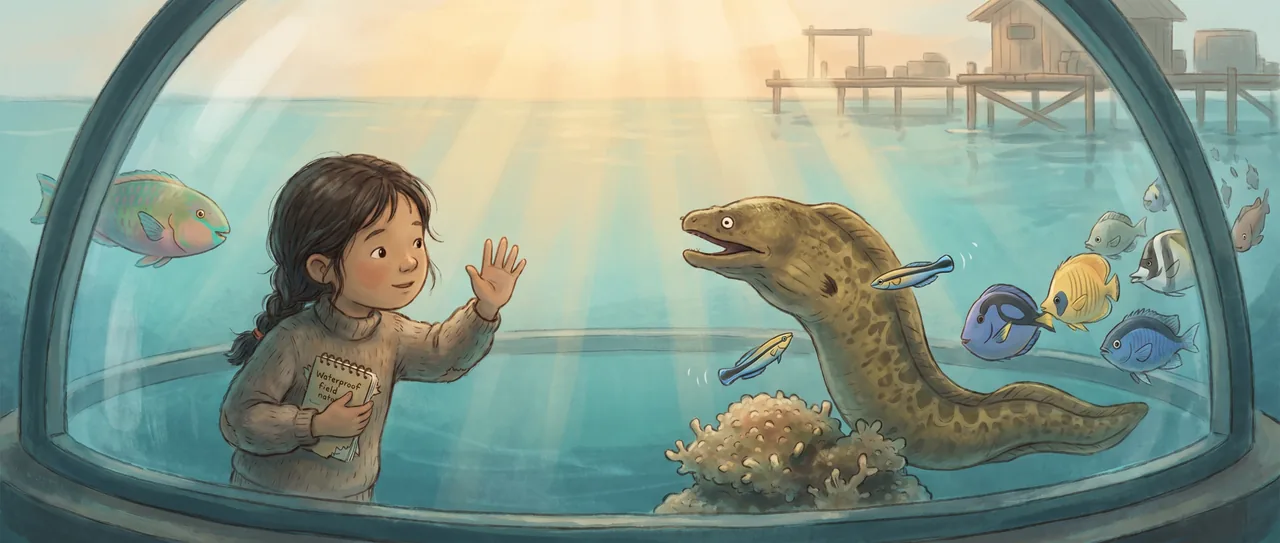
The Truce at Meridian Reef
The first thing Dara noticed about the grouper was that it was waiting.
She pressed her mask closer to the observation dome's glass and held her breath, even though she didn't need to. The Nassau grouper — easily a meter long, jaws wide enough to swallow a football — hovered motionless above a knob of coral, its mouth open, its gill covers flared. It looked like it was yawning. It looked patient.
A tiny wrasse, no bigger than Dara's pinky finger, swam directly into the grouper's mouth.
"It's eating it," Dara whispered. Then: "Wait. No, it isn't."
The wrasse darted between the grouper's teeth, picked at something, and backed out. The grouper didn't flinch. The wrasse circled, went in again. Came out again. The grouper closed its mouth gently, like someone finishing a yawn, then drifted aside.
Behind it — Dara counted — seven more fish were waiting. A parrotfish. Two tangs. A moray eel whose ribboning body made her stomach drop. And three other fish she couldn't name, all just... hovering. In a line. At the same small coral head. Like they were queuing for lunch at school.
Except some of them were lunch.
Dara pulled out her reef notebook — waterproof, battered, already half-full of sketches nobody had asked her to make. She wrote: *Moray eel waiting behind parrotfish. Parrotfish = prey of moray. Neither seems bothered. WHY?*
She underlined WHY three times.
The research village of Meridian Reef floated above the Coral Triangle on pontoons that rocked gently with the swell. Dara's mother was a structural engineer who maintained the pontoons. She didn't study fish. Nobody here had asked Dara to study fish. But the observation dome was open to anyone, and Dara was the only person who sat there at five in the morning, when the reef woke up.
She'd been watching the cleaning station for nine days.
On day one, she'd thought it was random — little fish near big fish, everyone minding their business. By day three, she'd noticed the pattern: the same coral head, the same little wrasses, the same parade of visitors. By day six, she'd started timing things. The average visit lasted forty seconds. The average wait was two minutes. No one cut in line. No one ate anyone.
It was, she realized, a truce. An actual truce. Predators and prey, side by side, operating under a rule that nobody had written down but everybody followed: *not here. Not now.*
Today she wanted to understand why it held.
She watched the moray eel glide forward for its turn. The wrasses went to work immediately — one at the gills, one near the tail. The moray's body, which usually moved like a fist looking for something to hit, went slack. Relaxed. The parrotfish that had been in front of it — a fish the moray could easily kill — drifted only a few body-lengths away, unconcerned.
Dara wrote: *The eel NEEDS the wrasses. If it ate the parrotfish here, the wrasses might flee. No more cleaning. So the truce isn't about being nice. It's about — *
She stopped. Chewed her pencil.
*It's about the station being more valuable than any single meal.*
Something clicked in her chest. Not like solving a math problem. More like a lock turning in a door she hadn't known was there.
She flipped back through her notebook. Nine days of sketches and timings and tiny questions. She found her day-four note: *Wrasse touched the eel 6 times in 30 seconds. Touched the grouper only 3 times. Bigger client = more touches? More parasites? Or is the wrasse being EXTRA to the dangerous one?*
She looked back through the glass. A new wrasse was attending a barracuda now — a silver torpedo of a fish that could move faster than Dara could think. The wrasse performed a strange little dance before approaching: a bobbing, side-to-side shimmy.
Dara had seen that dance every single morning. She'd sketched it eleven times without understanding it.
Now she did.
"You're advertising," she said out loud. "You're saying, *I'm the cleaner, I'm safe, this is my station, come here.*" She pressed her hand flat against the glass. "And they believe you. The barracuda believes a fish the size of a crayon."
The barracuda held still. The wrasse danced, then cleaned. The truce held.
Dara sat back in her chair and stared at the reef — really stared — and for a moment the whole thing shifted. She wasn't looking at a reef anymore. She was looking at a city. The cleaning stations were hospitals, or markets, or crossroads — places so essential that even enemies agreed to lower their weapons. The wrasses weren't just fish. They were the reason the truce existed. Remove them, and the whole arrangement collapsed. Every predator would go back to hunting here. Every prey fish would flee. The reef's economy — she almost laughed at the word, but it was right — would break.
A tiny fish, the length of a crayon, was holding the peace.
She thought about herself — small, quiet, always noticing things other people walked past. Her mother called it "getting lost in details." Her teachers called it "unfocused attention." Dara called it looking. Just looking.
And now nine days of looking had shown her something enormous: that cooperation wasn't just a nice idea people talked about in school assemblies. It was a force. It was built into the architecture of the reef the way gravity was built into the architecture of planets. It emerged — not because anyone decided to be kind, but because the wrasse danced, and the barracuda held still, and holding still was worth more than striking.
She opened to a blank page and began to write a new question, the biggest one yet:
*If a cleaning station is a place where the rules of predator-and-prey get suspended — where else does this happen? Are there truces like this everywhere in nature, and we just haven't learned to see them yet?*
Below the reef, the moray eel and the parrotfish drifted in opposite directions, alive, clean, unharmed. The wrasses returned to their coral head and began to dance again.
The next customer was already waiting.
Dara closed her notebook and opened it again immediately, because she'd just thought of something else — a pattern in the timing data, something about dawn versus midday, something she almost understood.
She leaned forward. The reef was waking up. And so, she felt with a shiver she couldn't name, was she.
Read the interactive version, listen to the narration, and earn a gold star →
A science-verified short story for curious kids · Curiosity Land