The Girl Who Watched Things Grow Back
Lúz had been counting the toes for eleven days.
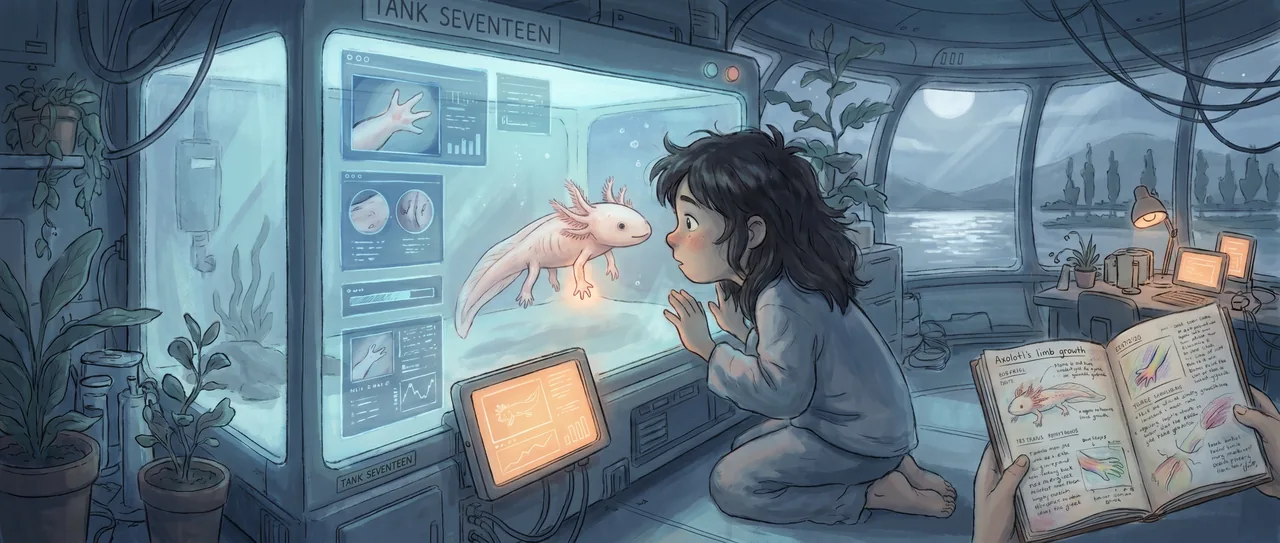
Every morning before the research station woke up, she climbed down from her bunk, padded barefoot across the cool biofilm floor, and pressed her face to Tank Seventeen. Inside, a pale axolotl named Domingo floated in water so clear it looked like he was swimming in light. His left forelimb — the one Dr. Reyes had surgically removed on Day Zero as part of the regeneration study — was coming back.
Not scarring over. Not healing into a stump. Coming back.
On Day Three, a tiny bump had appeared, like a translucent blister. By Day Five, it was a cone of tissue, and Lúz could see something moving inside it — cells organizing themselves, deciding what to become. By Day Eight, she could count four pale nubs that would be fingers. Today, Day Eleven, Domingo had toes. Tiny, perfect, feathery toes, each one with a nail so small it was almost imaginary.
"You're here early again," said the station's research AI, Cēlo, its voice soft as lake water. A gentle chime, not an alarm.
"I had to check," Lúz whispered. "The fourth toe has a nail now."
"Noted. Shall I log it?"
"Already drew it." She held up her notebook — pages dense with colored pencil sketches, each dated, each labeled with measurements she'd taken using the tank's magnification display. Nobody had asked her to do this. The other junior researchers slept until the breakfast tone. Lúz couldn't. Not when something this impossible was happening three meters from her pillow.
The thing she couldn't stop thinking about — the thing that made her skull feel too small for her brain — was that Domingo's body didn't just patch the wound. It remembered what was supposed to be there. It rebuilt a limb with bones and muscles and blood vessels and nerves, all wired together, all working, as if the blueprint had never been lost.
And it wasn't just limbs. Dr. Reyes had told them during orientation that axolotls could regenerate portions of their heart. Pieces of their actual brain. Not scar tissue. Not workarounds. The real thing, restored.
How did the cells know?
That was the question that kept her up. That was the question she'd written in red ink and circled three times on page forty-one of her notebook.
How. Did. The. Cells. Know.
"Cēlo," she said. "When Domingo's limb was cut, the cells at the wound site — they de-differentiated, right? They went backwards? Became like stem cells again?"
"That's correct. The mature cells at the wound site lose their specialized identity and form a blastema — a mound of cells that essentially become young again. Then they re-specialize."
"So a muscle cell forgets it's a muscle cell."
"In a sense."
"And then remembers what it's supposed to become."
"In a sense."
Lúz pressed her forehead against the cool glass. Domingo drifted closer, his external gills rippling like tiny ferns, his round black eyes holding what she privately thought was a very patient expression.
At the morning meeting, Dr. Reyes reviewed the data from all twenty tanks. Lúz listened the way she always listened — with her whole body tilted forward, pencil moving. When the session ended, Dr. Reyes asked if anyone had questions.
Nobody raised a hand. They never did. Lúz's hand went up like a reflex.
"Why can't we do it?"
Dr. Reyes tilted her head. "Can you clarify?"
"Humans have most of the same genes axolotls use for regeneration. You said that on Day One. We have the genes. So why can't we regrow a finger?"
The room was quiet. Lúz felt the familiar flush — the one that came when she'd asked a question that made people blink. Too intense, her old school reports said. Asks questions beyond the scope of the lesson.
"That," Dr. Reyes said slowly, "is the central question of the entire field. We think our immune system responds too aggressively — it scars the wound closed before a blastema can form. The axolotl's immune response is gentler. It gives the cells time to remember."
Time to remember.
Lúz wrote it down. Then she drew a line connecting it to her red-circled question on page forty-one.
That night, she couldn't sleep. She pulled up the station's open research archive on her reader and found a paper from 2819 — a team in Oaxaca had managed to slow the scarring response in human skin cells, and for seventeen hours, those cells had begun to form something like a blastema. Seventeen hours of cells remembering, before the body shut it down.
Seventeen hours.
She sat up in her bunk, heart knocking.
It wasn't that human beings couldn't regenerate. It was that something in them kept interrupting the process. The machinery was there. The blueprint was there. Locked behind a door that the body kept slamming shut.
She climbed down and pressed her face to Tank Seventeen. Domingo floated near the glass, his new left forelimb flexing gently — all four toes spread, each one catching light.
"You don't slam the door," she whispered. "That's the whole difference, isn't it? You just let the cells have time."
Domingo's gills rippled.
Lúz opened her notebook to a fresh page. She wrote the date. She wrote: What if we could teach human cells to be patient?
Underneath, she began to sketch — not Domingo this time, but a diagram. A human wound site. Arrows showing immune cells arriving. A dotted line where they might be slowed, delayed, quieted. A blastema forming beneath, like a seed opening underground.
She didn't have the answer. She had something better.
She had the shape of the right question.
Outside the station, Lake Xochimilco glittered in moonlight, two thousand years older than the city surrounding it, and full of creatures who carried in their small pale bodies a secret that human beings were only beginning to learn how to ask about — that healing was not about closing wounds.
It was about giving cells the time to remember what they already knew how to become.
Read the interactive version, listen to the narration, and earn a gold star →
A science-verified short story for curious kids · Curiosity Land