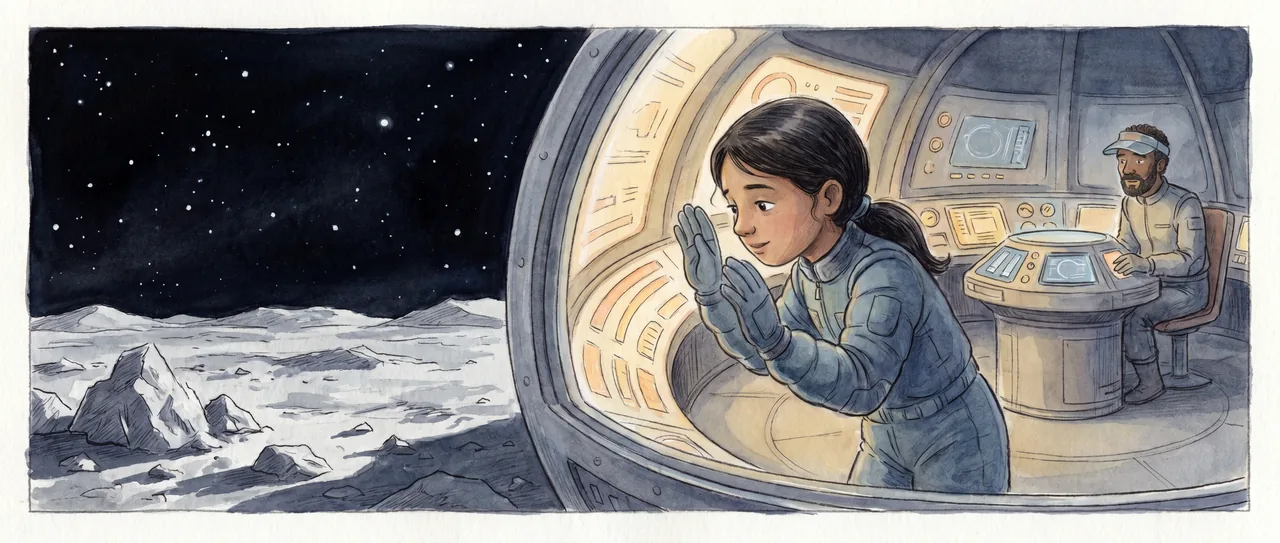
The Girl Who Saw the Gaps
The first thing Priya noticed about the Moon was that the shadows were wrong.
Not wrong exactly. They were sharp — sharper than any shadow she'd ever seen on Earth. No atmosphere to scatter light meant each shadow was a blade, a cutout, a black shape with edges so crisp they looked painted on the regolith. She'd read about this. She'd expected it.
But her brain kept softening them.
She'd look at a boulder near the station's outer dome and see a shadow with fuzzy edges, the way shadows were supposed to look, the way every shadow she'd ever seen in her ten years on Earth had looked. Then she'd blink, focus harder, and there it was — the knife-edge line between light and absolute dark.
"You're doing it again," said her older brother Kavya, not looking up from his tablet. "Staring at rocks."
"The shadows keep changing."
"They don't. The Moon has no wind. Nothing moves."
"I know nothing's moving out there. Something's moving in here." She tapped her temple.
Kavya finally looked up. "You're so weird."
Priya didn't argue with this. She'd been told it before — by classmates who didn't understand why she watched ceiling fans until she could see the individual blades, by teachers who caught her staring at her own hand opening and closing like it belonged to someone else. She paid attention to things most people had decided weren't interesting. She hadn't decided that yet.
The research station was called Chandra, and their mother was one of the neuroscientists there studying how human perception adapted to the lunar environment. Priya wasn't supposed to be in the Perception Lab, but the door was open and the hallway was long and her feet — wonderfully light in one-sixth gravity — carried her in before the thought fully formed.
The lab was a circular room with curved screens lining every wall. Dr. Okafor, her mother's colleague, sat in the center with a visor pushed up on his forehead.
"Priya. You have that look."
"What look?"
"The look your mother gets when she's about to ask an inconvenient question."
Priya smiled. "Why does my brain keep making the shadows fuzzy? I know they're sharp. I've read about vacuum shadows. But I keep seeing Earth shadows instead of Moon shadows."
Dr. Okafor leaned back. He didn't give her an answer. He did something better — he gave her a demonstration. He tapped his console, and the screens around the room lit up with a simple image: a gray circle on a white background.
"What do you see?"
"A gray circle."
He tapped again. The image flickered — just for a frame — and was replaced by an identical gray circle, except Priya could swear it was now slightly lighter.
"Did you change the color?"
"No. I changed the background. It's a tiny bit darker now." He showed her the values. The circle was exactly the same shade. "Your brain isn't showing you the circle. It's showing you a guess — a prediction about what the circle should look like based on everything around it. You're not seeing reality, Priya. You never have been. Nobody has."
The room seemed to tilt. Not physically. Something shifted behind her eyes.
"Wait," she said slowly. "So what I see right now — this room, you, my own hands — that's not... a recording? Like a camera feed?"
"Your brain has never worked like a camera. It works like... imagine a painter who's very, very fast. Before your eyes even finish sending a signal, your brain has already painted what it expects to see, based on every single thing you've ever seen before. Then it checks the signal and fixes any mistakes. But it only fixes the big ones. The small ones — like how sharp a shadow should be — it just... keeps the painting."
Priya looked at her hand. She turned it over slowly. She was seeing a prediction of her hand. Her brain's best guess, rendered so fast and so convincingly that she'd spent ten years thinking it was the truth.
The whole world was a painting. The whole world was a story her brain was telling her, updated second by second, and she had never once thought to check.
"That's why I keep seeing fuzzy shadows," she whispered. "My brain has ten years of Earth shadows. It's painting those instead."
"Every new arrival on the Moon sees Earth shadows for the first week. The brain's predictions are very stubborn."
"But I noticed." She said it quietly, almost to herself. "I noticed the shadows were being softened. Before anyone told me. I saw the gap between what's out there and what my brain was painting."
Dr. Okafor studied her for a long moment. "Most people don't. Most people's brains are too good at the trick. They never see the brush strokes."
Priya walked to the curved window at the far end of the lab. The lunar surface stretched out under a black sky dense with stars that did not twinkle — because twinkling was an atmosphere effect, and there was no atmosphere, and her brain was gently trying to make them twinkle anyway. She could feel it, now that she knew what to feel for. A tiny disagreement between the world and the painting.
She pressed her fingers to the glass.
Every person she'd ever known was walking around inside a painting their own brain made. Every argument about what color something was, every disagreement about what happened, every time someone said "that's not what I saw" — they were all right. They were all seeing their own painting. Their own prediction. Built from their own life.
And the actual universe — the raw, uninterpreted, unpainted universe — was right there behind the brush strokes, waiting for anyone patient enough to notice the gaps.
She thought of every time she'd been called weird for staring too long, paying too much attention, questioning things everyone else had already filed away as settled. She'd been doing it her whole life without knowing why.
Now she knew. She'd been looking for the gaps.
She stared at the stars. Steady, unwavering points against the void. Her brain tried once more to make them twinkle. She watched it happen. She watched herself overrule it.
The stars held still.
"Dr. Okafor," she said, not turning from the window. "If the brain can be wrong about shadows and colors and twinkling... what else is it painting that nobody's checked yet?"
He was quiet for a long time.
"That," he said, "is the right question."
Priya pressed her forehead against the cool glass and looked out at a universe that was — she now understood — bigger than anyone's painting of it. Bigger than anyone's brain could hold.
Somewhere behind her eyes, the painter kept working. And Priya kept watching it paint, searching for the places where the brush strokes showed.
Read the interactive version, listen to the narration, and earn a gold star →
A science-verified short story for curious kids · Curiosity Land