The Girl Who Listened to Rivers
The river was wrong.
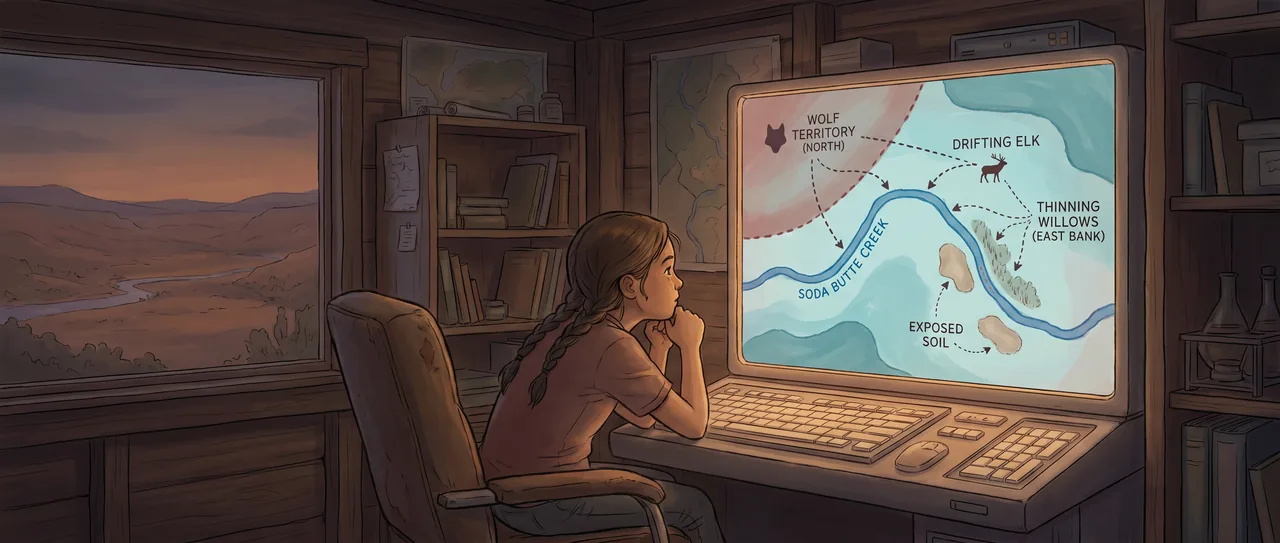
Not wrong like broken. Wrong like a word you keep misspelling even though you know better. Maren had been staring at the drone overlay for forty minutes, chin on her fists, watching the blue line of Soda Butte Creek refuse to match the prediction model.
"It's shifting east," she said to no one. The monitoring station was empty. Her mother was upstream collecting sediment cores with Dr. Achebe, and they wouldn't be back until evening. Maren was supposed to be logging vegetation density from the satellite scans — boring, careful, necessary work.
But the river was wrong, and she couldn't stop looking at it.
She pulled up the historical overlays, the ones that went all the way back to the 2020s. The earliest images showed a creek that wandered like a restless sleeper — wide and braided, sprawling across the valley floor in shallow channels that shifted every spring. The banks were bare then. Just gravel and mud and the pale ghosts of root systems that couldn't hold.
Then the wolves came back.
Maren knew the story. Everyone who spent time at Lamar Station knew the story — it was practically the first thing they told you. Wolves returned to Yellowstone in 1995. They hunted elk. The elk stopped lingering near riverbanks, stopped chewing every willow and aspen down to nothing. And without anyone planting a single seed, the trees came back. Cottonwoods. Willows. Their roots gripped the soil. The soil held the banks. The banks narrowed the channel. The water deepened and quickened. Songbirds returned to branches that hadn't existed five years before. Beavers came back to build dams in streams that could finally support them.
Wolves changed the course of rivers. Not by touching the water. By changing what happened beside it.
Maren had heard this story maybe two hundred times. She still got goosebumps.
But now the creek was shifting east again, and the model said it shouldn't be. The vegetation maps showed dense canopy along the western bank — healthy willows, mature cottonwoods. That bank should be holding firm. She zoomed in on the eastern bank and stopped.
"Oh," she said.
The eastern bank was thinning.
Not dramatically. Not in a way that would show up on a weekly report. But the satellite scans from the last three seasons, layered on top of each other, told a story. The willow coverage on the east bank had dropped nine percent. The understory was patchy. And in two spots, she could see the pale signature of exposed soil.
She almost called her mother. Her thumb hovered over the comm. But the question was still forming, and Maren had learned — the hard way, the wonderful way — that calling someone with a half-formed question meant getting their answer instead of her own.
She pulled up the elk movement data instead.
The monitoring station tracked everything. Wolves wore GPS collars. Elk herds were counted by drone twice a month. Maren layered the wolf territory maps over the creek and felt the hair rise on her arms.
Wolf Pack 7 — the Druid Peak descendants — had denned further north this year. Almost two kilometers further than last season. Their territory had pulled away from the eastern bank of Soda Butte Creek like a blanket sliding off a bed.
And into that gap, the elk had drifted.
Not because anyone told them to. Not because they thought about it. They simply went where the fear wasn't. They grazed the eastern willows because no footprint in the mud, no scent on the wind, told them not to. The willows thinned. The roots loosened. The bank softened. The river noticed.
Maren sat back in her chair and felt the monitoring station expand around her — felt the valley expand — felt the whole connected web of teeth and roots and water and soil expand until she couldn't hold it all in her chest.
One wolf pack moved its den two kilometers north. And a river began to change direction.
She wasn't scared. She was amazed. The world was not made of separate things. It was made of relationships so intricate that a den site and a river bend were the same story, told in different languages.
Maren started building the report. Not the vegetation log she was supposed to file — a new one. She overlaid wolf territory shifts, elk grazing pressure, willow density, and bank erosion rate, season by season. She color-coded the correlations. She marked the two exposed-soil sites on the eastern bank and calculated, roughly, how much sediment they were losing per rainfall event.
Then she added a projection. If Pack 7 stayed north through next spring — if the elk kept grazing the eastern willows — the creek would migrate 1.3 meters east within two years. The beaver dam at the bend below would be undermined. The pool behind it, where cutthroat trout spawned in June, would drain shallow and warm.
From wolves to trout. From fear to water. Everything connected.
She flagged the report with a priority marker and sent it to Dr. Achebe's field tablet. Then she sat for a while, watching the blue line of the creek on the live feed, the water moving the way water moves — always finding the path that the world around it allows.
Her comm buzzed twenty minutes later.
"Maren." Dr. Achebe's voice was careful, the way it got when she was thinking fast. "Did you build this overlay yourself?"
"Yes."
A pause. "The eastern bank correlation. I've been watching the sediment numbers, but I didn't connect it to the territory shift. How did you see it?"
Maren almost said she didn't know. But that wasn't true.
"The river was doing something it shouldn't have been doing," she said. "So I kept looking until I found what was making it."
Another pause. Longer. Then Dr. Achebe laughed — not at Maren, but the way people laugh when something delights them.
"Stay at the console. I'm sending you the sediment core data from this afternoon. I want to see what you do with it."
The comm clicked off. The station hummed. Outside, the valley held its vast and quiet conversation — wolf and elk and willow and water, endlessly reshaping each other in ways that no one had finished mapping.
Maren opened the incoming file and leaned forward.
Somewhere east, the creek pressed against softening soil, finding a new path that nobody had predicted yet, carrying silt toward a future that was still being written by everything alive in the valley — including, now, a twelve-year-old girl who couldn't stop asking why the river was wrong.
Read the interactive version, listen to the narration, and earn a gold star →
A science-verified short story for curious kids · Curiosity Land