The Counting Garden
Maren had been wrong about the sunflower for eleven days.
She'd planted it as part of the Rooftop Lab's growth-mapping project, the one where every kid in the program got a plot, a sensor kit, and a question to answer. Most kids asked normal things: does music help plants grow, does the color of light matter, can you train a vine to spell your name.
Maren had written on her project card: Why does my sunflower look like math?
Ms. Okoro had read it, smiled in that way adults smile when they don't understand your question but don't want to say so, and signed the approval.
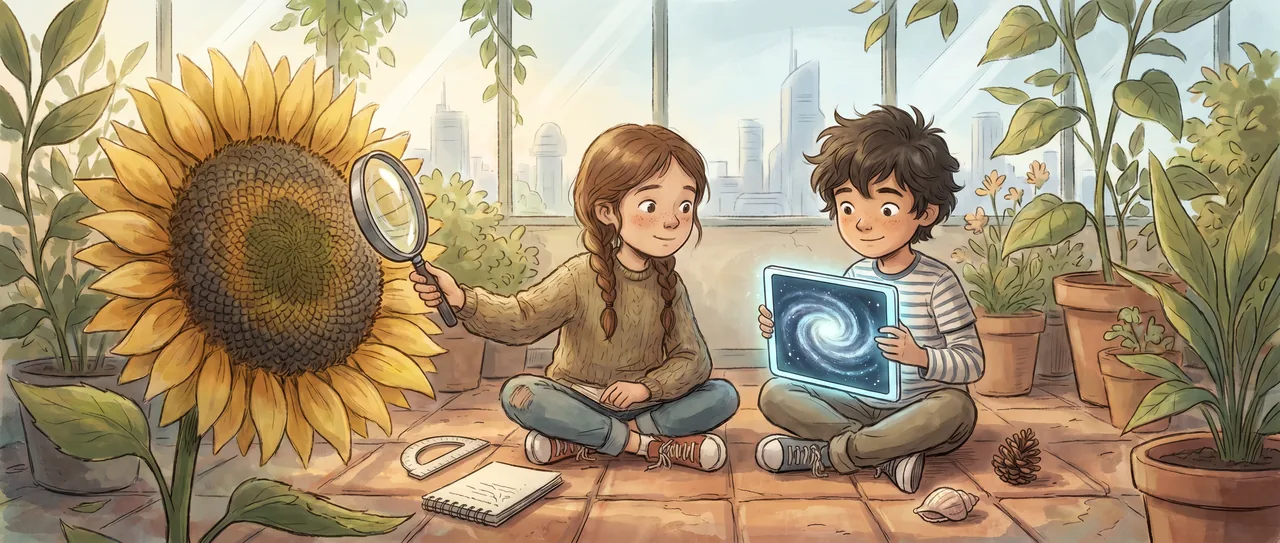
That was eleven days ago. Since then, Maren had spent every morning before the other kids arrived sitting cross-legged on the warm greenhouse tiles, staring into the face of her sunflower as its seeds began to form. She'd brought a magnifying lens. A protractor she'd borrowed from her older brother. A notebook that was filling up with drawings that looked, she had to admit, a little obsessive.
The seeds weren't random. She'd known that on day one. They spiraled — clockwise and counterclockwise at the same time, two sets of curves braided together like someone had choreographed them. She'd counted the spirals going one way. Thirteen. She'd counted the other way. Twenty-one.
Thirteen and twenty-one. She'd written those numbers in her notebook and stared at them for a long time, feeling like they were trying to tell her something in a language she almost spoke.
On day four, she'd picked up a pine cone from the path outside the building. She counted its spirals too. Eight one way. Thirteen the other.
Eight. Thirteen. Twenty-one.
She'd written the numbers in a column and added the obvious ones around them: 1, 1, 2, 3, 5, 8, 13, 21. Each number the sum of the two before it. She knew this sequence — she'd seen it in a math video once, a man with wild hair talking too fast about rabbits. Fibonacci. But the video had made it sound like a trick, a curiosity, a fun fact for the back of a cereal box.
It didn't feel like a fun fact when she was holding a pine cone in one hand and a sunflower in the other and they were both saying the same numbers.
On day seven, Kai sat down next to her. Kai, who never talked to anyone, who spent all his time with the telescope on the east platform, mapping spiral galaxies for his own project.
"You're counting," he said.
"I'm counting," she agreed.
"I count too." He set his tablet down between them. On the screen was a photograph of a galaxy — a great whirlpool of light, arms curving outward from a bright center. "The arms," he said. "I keep getting Fibonacci numbers."
Maren felt something shift behind her ribs. Not surprise exactly. More like a lock turning.
"Show me," she said.
They spent the next three days comparing everything. His galaxies. Her sunflower. Pine cones, nautilus shell cross-sections from the biology library, the spiral arrangement of leaves on a stem — which Maren counted herself, twice, because she didn't believe it the first time. The numbers kept coming back. The same ones. The same sequence. In things that had no connection to each other — no shared DNA, no shared designer, no reason at all to match.
On day ten, Maren asked the greenhouse AI to model what would happen if sunflower seeds tried to pack themselves using a different angle — not the Fibonacci-linked angle of 137.5 degrees, but something else. Anything else.
The AI ran it. Every other angle left gaps. Wasted space. Seeds clumped together or left empty rings. Only the golden angle — the one derived from the Fibonacci ratio — filled the space perfectly, every seed equidistant, no room wasted, as tight and elegant as a solved equation.
"It's not a design," Maren said slowly. She was talking to Kai, but really she was talking to herself, to the feeling building in her chest. "Nobody decided this. The sunflower doesn't know math. The galaxy doesn't know math. It's just — if you're growing outward from a center, and you want to waste nothing, this is the only way. The math was already there. The universe just... falls into it."
Kai was quiet for a long time. Then he said, "Like gravity. Nobody chose it. It's just what happens when there's mass."
"Yes," Maren whispered. "Exactly like that."
She looked at the sunflower. She looked at Kai's galaxy, still glowing on the tablet between them. A flower the size of her hand. A galaxy a hundred thousand light-years across. Both obeying the same quiet rule. Not because anyone told them to. Because efficiency has a shape, and the shape has a number, and the number was always going to be this one.
The greenhouse hummed around them. Other kids laughed and measured and sprayed water at each other. The city murmured far below.
Maren opened her notebook to a fresh page. She wrote:
Things I haven't checked yet: - hurricanes? - DNA helix? - the way water drains? - the inside of my own ear?
Kai read over her shoulder. "You think it goes further?"
Maren looked at him — this quiet boy who counted the arms of galaxies because he couldn't help it, because the numbers called to him the same way they called to her. She thought about how big the universe had just gotten. Not bigger in size. Bigger in connectedness. Every spiral she would ever see for the rest of her life was going to whisper the same sequence, and she was going to hear it, and she was never going to be able to stop hearing it.
She smiled.
"I think it goes everywhere," she said. "I think we've barely started counting."
Read the interactive version, listen to the narration, and earn a gold star →
A science-verified short story for curious kids · Curiosity Land