Both Doors
The other kids had already moved on to the magnet station, but Mira stayed.
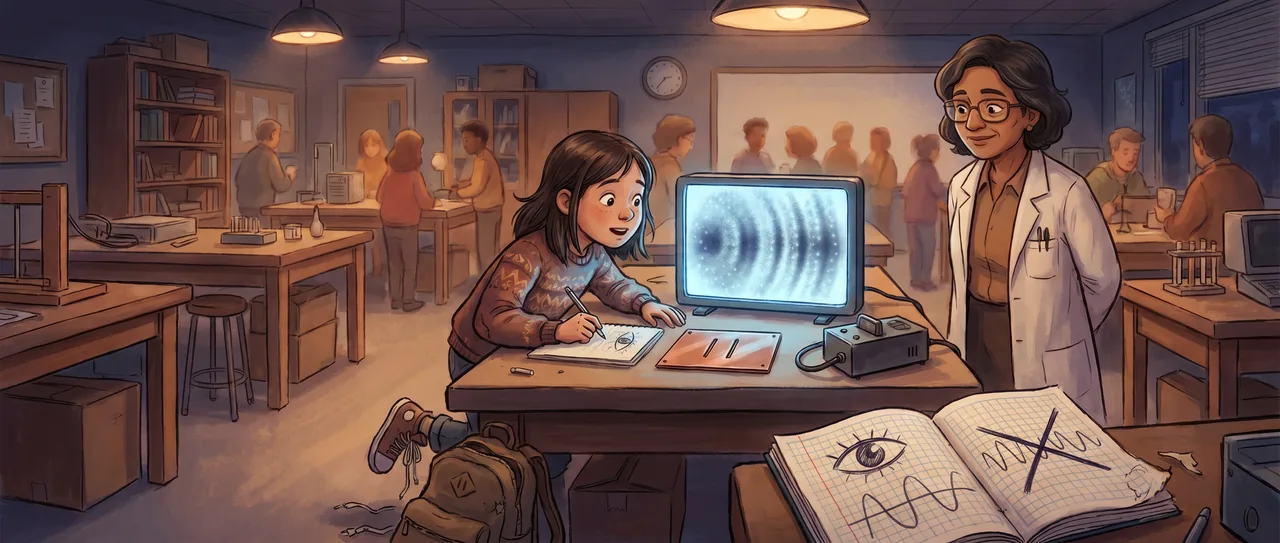
She was staring at a pattern on the detector screen — soft bands of light and dark, like tiny ripples frozen mid-wave. Dr. Kapoor had fired electrons through two slits in a copper plate, one electron at a time, and the pattern had built up slowly, dot by dot, over twenty minutes. It looked like interference. Like waves overlapping in a pond.
But electrons weren't waves. They were particles. Tiny bullets of matter. Dr. Kapoor had said so herself.
"How does one electron interfere with itself?" Mira asked.
Dr. Kapoor smiled the way adults smile when they're pleased but trying not to show it. "That's the right question. What do you think?"
"It can't go through both slits. It's one electron."
"And yet." Dr. Kapoor gestured at the rippled pattern on the screen.
Mira leaned closer. Each dot was a single electron striking the detector. One at a time. But together, over hundreds of impacts, they arranged themselves into bands — the signature of a wave passing through two openings at once. As if each electron, traveling alone, had somehow passed through both slits simultaneously.
"That's impossible," Mira said. Not as a complaint. As an observation.
"Would you like to see something stranger?"
Dr. Kapoor reached behind the copper plate and switched on a small device — a detector positioned right at the two slits, designed to record which slit each electron actually passed through.
"Now we watch," she said.
The screen cleared. New dots began to appear, one by one.
Mira watched for five minutes. Then ten. Her sneakers were untied and her stomach was growling and she didn't move.
The pattern was different.
No ripples. No interference bands. Just two bright clusters, one behind each slit. Exactly what you'd expect if electrons were ordinary particles choosing one door or the other.
"You changed it," Mira whispered.
"I measured it."
"But that's — the electrons know?"
Dr. Kapoor turned off the detector at the slits. "Watch again."
The ripples came back. Slowly, dot by dot, the interference pattern rebuilt itself. The electrons were passing through both slits again — but only because nobody was checking which slit they used.
Mira's hands were gripping the edge of the table. She could feel her pulse in her fingertips.
"It's not that they know," she said slowly. "It's that measuring them forces them to be one thing. To pick a slit. But when nobody measures, they don't have to pick. They're... both. At the same time."
Dr. Kapoor said nothing. She just watched Mira the way Mira was watching the screen.
The other kids were laughing at the magnet station. Someone had gotten iron filings in their hair. The Saturday lab was chaotic, cheerful, loud. Mira barely heard any of it.
She was thinking about what it meant for something to be in two states at once. Not confused. Not undecided. Actually, genuinely, physically both — until the moment the universe was forced to answer a yes-or-no question.
She thought about all the times people told her to just pick one thing. Pick a hobby. Pick a favorite subject. Stop asking so many questions about everything and just focus. As if being interested in everything was a problem to solve. As if she needed to collapse into one version of herself so other people could measure her more easily.
"Dr. Kapoor?"
"Yes?"
"Does it bother physicists? That looking at something changes what it does?"
"It used to. Some of them spent decades trying to prove it couldn't be true. They designed more and more clever experiments, certain they'd find a loophole."
"Did they?"
"No. Every experiment confirmed it. The universe really does work this way. The act of observation is not passive. It participates."
Mira sat with that. She pulled her notebook from her backpack — the battered one with the graph-paper pages that she carried everywhere because she never knew when she'd need to sketch an idea. She drew the two slits. She drew the interference pattern, then the two clusters. She drew an eye above the slits and put a big X through the ripples.
Then she wrote, in her careful handwriting: *The question you ask changes the answer you get.*
She stared at that sentence for a long time.
"Dr. Kapoor. If this is true for electrons, is it true for bigger things? For atoms? Molecules?"
"Researchers have demonstrated interference with molecules of sixty carbon atoms. Bigger every year. There's no known size limit where quantum behavior simply stops."
"So where does it stop?"
"That," Dr. Kapoor said, "is one of the biggest open questions in physics."
Mira looked up from her notebook. The lab suddenly felt enormous — not the room itself, but what the room contained. Every surface, every wall, every atom in her own hand was made of particles that behaved like this. That existed in multiple states until forced to choose. The solid, certain world she walked through every day was built on a foundation that was anything but solid. Anything but certain.
And nobody knew why.
Nobody in the whole world knew why.
The thought should have been frightening. Instead it felt like a door swinging open onto a room so vast she couldn't see the walls.
"Can I stay for the next session?" Mira asked.
"The next session is for the twelve-year-olds. It's on quantum entanglement."
"Is that the thing where two particles are connected even when they're far apart?"
"You've been reading."
"I've been wondering."
Dr. Kapoor handed her a stool. "Stay."
Mira opened her notebook to a fresh page. The graph-paper grid stretched out in tiny blue squares, empty and waiting, like a detector screen before the first electron arrives.
She uncapped her pen.
Somewhere in the copper plate, an electron that was not yet measured drifted toward two slits, and for one long, perfect, unmeasured moment, it was everywhere it could possibly be.
Read the interactive version, listen to the narration, and earn a gold star →
A science-verified short story for curious kids · Curiosity Land