What the Roots Were Saying
The dead tree was the one that didn't make sense.
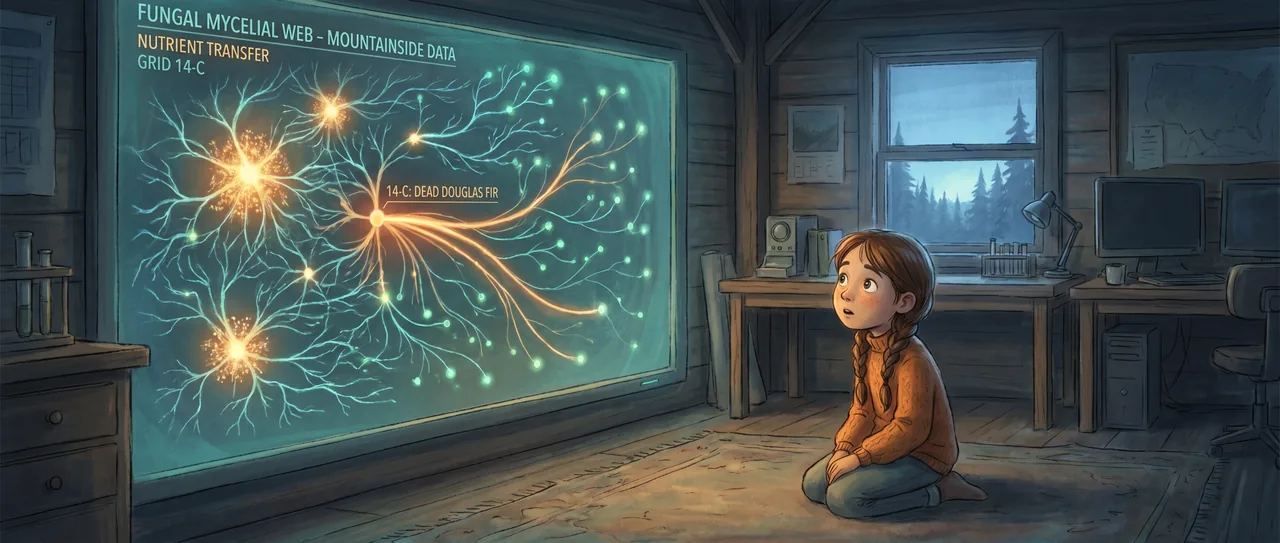
Mira had been staring at the data for three days. Every morning she biked to the Cascadia Reforestation Station before anyone else arrived, sat cross-legged on the floor of the monitoring lab, and pulled up the nutrient maps on the old wall screen. The station's AI, Linden, kept the data flowing from thousands of tiny sensors buried in the soil across two hundred acres of recovering forest.
"You're here early again," Linden said, its voice like warm tea.
"The Douglas fir in grid 14-C is dead," Mira said. "But the seedlings around it are growing faster than seedlings anywhere else on the whole site. That doesn't make sense."
"It doesn't," Linden agreed.
That was the thing Mira liked about Linden. It never pretended something made sense when it didn't. Her teachers sometimes did that — smiled and said "good question" and then moved on, which was the same as saying "stop asking." Linden never did that.
Mira's mother, Dr. Okafor, ran the reforestation station. She'd brought Mira here two years ago when the project began, replanting a mountainside that had been clearcut decades before. The saplings were doing well. Most of them. The mystery was why some were doing so much better than others, even in identical soil, with identical rain and identical sun.
Mira had started mapping the differences six months ago because nobody told her not to.
"Linden, show me the carbon-13 tracer data for grid 14."
The wall bloomed with color. Earlier that month, the research team had injected carbon-13 — a harmless, trackable form of carbon — into several mature trees to see where the nutrients traveled. The tracers were supposed to stay in the trees that received them.
They hadn't.
"The carbon moved," Mira whispered.
She could see it. The tagged carbon had traveled from the injected trees outward — not through the air, not through water runoff, but underground. Through the soil. Into neighboring trees. Into seedlings thirty feet away.
"Linden, what's in the soil between these trees?"
"Fungal mycelium. Primarily Rhizopogon and Cenococcum species. The sensor array shows extensive hyphal networks connecting root systems across the grid."
Mira knew about mycorrhizae. She'd read her mother's papers. Fungi that wrapped around tree roots, trading minerals for sugar. But this was something else. This wasn't just trade. This was a network.
"Show me the whole site."
The wall transformed. Two hundred acres of forest floor, rendered in threads of light. And Mira's breath stopped.
The fungal connections weren't random. They formed a web — a sprawling, branching, impossibly intricate web — connecting nearly every tree on the mountainside. The oldest surviving trees, the ones that had been left standing after the clearcutting, sat at the centers of the densest clusters, like hubs in a network. Hundreds of threads radiated from each one.
Mira stood up slowly.
"The old trees are feeding the young ones," she said.
"The data supports that interpretation," Linden said.
"But grid 14-C. The dead fir." Mira pulled up the dead tree's data. "Before it died — Linden, what was it doing in the last month?"
A pause. Then: "Carbon-13 outflow from the dying Douglas fir increased four hundred percent in the final three weeks before death. Phosphorus and nitrogen outflow increased similarly. All nutrients flowed outward through the mycorrhizal network to surrounding seedlings."
Mira sat back down on the floor. Her eyes stung.
The tree had known it was dying. And as it died, it had dumped everything it had — every sugar, every mineral, every molecule it could spare — into the underground web. Into the seedlings. Into the future.
That was why those seedlings were growing faster than any others on the site.
They had been fed by a gift.
"Linden," Mira said quietly. "The team has been replanting saplings in open clearings. Away from the old trees. Because they thought the old trees would compete with them for light and water."
"That is the current planting protocol, yes."
"But the saplings near old trees are doing better. Because they're connected to the network. The old trees aren't competing. They're... parenting."
She pulled up the growth data and placed it side by side with the fungal map. The correlation was obvious. Seedlings connected to the mycorrhizal web grew forty percent faster. Seedlings planted in the open clearings — disconnected, isolated — struggled.
The reforestation project was planting trees in all the wrong places.
Mira heard boots on the steps outside. Her mother came in, rain-damp, holding two mugs of coffee. She stopped when she saw the wall screen.
"Mira, what is all this?"
Mira stood up.
"Mom, I think I need to show you something."
She walked her mother through it. The carbon tracers. The fungal web. The dying fir's last gift. The growth differentials. She spoke for ten minutes without stopping, pointing at the screen, pulling up datasets, her voice getting faster and higher the way it always did when the ideas came too quickly for her mouth.
Her mother set down both mugs of coffee. She stared at the wall.
"You mapped all of this yourself?"
"Linden helped with the sensor data. But I saw the pattern."
Dr. Okafor was quiet for a long time.
"We need to redesign the entire planting grid," she finally said. "Plant near the old trees. Connect the seedlings to the network."
"Yes."
Her mother looked at her. Really looked at her. "How long have you been coming in early?"
"Six months."
Dr. Okafor laughed — not a small laugh, a real one. "We have seventeen PhDs on this project, and my eleven-year-old found the thing none of us were looking for because she thought a dead tree was interesting."
Mira felt her face go warm. She looked at the floor.
But then she looked back at the wall. At the web. Thousands of trees, threaded together underground by organisms too small to see, passing life back and forth in the dark.
And something shifted in her chest — something enormous and quiet.
Because if this was happening here, on one mountainside in Oregon, it was happening everywhere. Every forest on Earth. The Amazon. The boreal. The cloud forests she'd never seen. Trillions of fungal threads carrying messages she didn't know how to read yet.
The forest wasn't a collection of trees.
It was a conversation.
And she had only just started listening.
Read the interactive version, listen to the narration, and earn a gold star →
A science-verified short story for curious kids · Curiosity Land