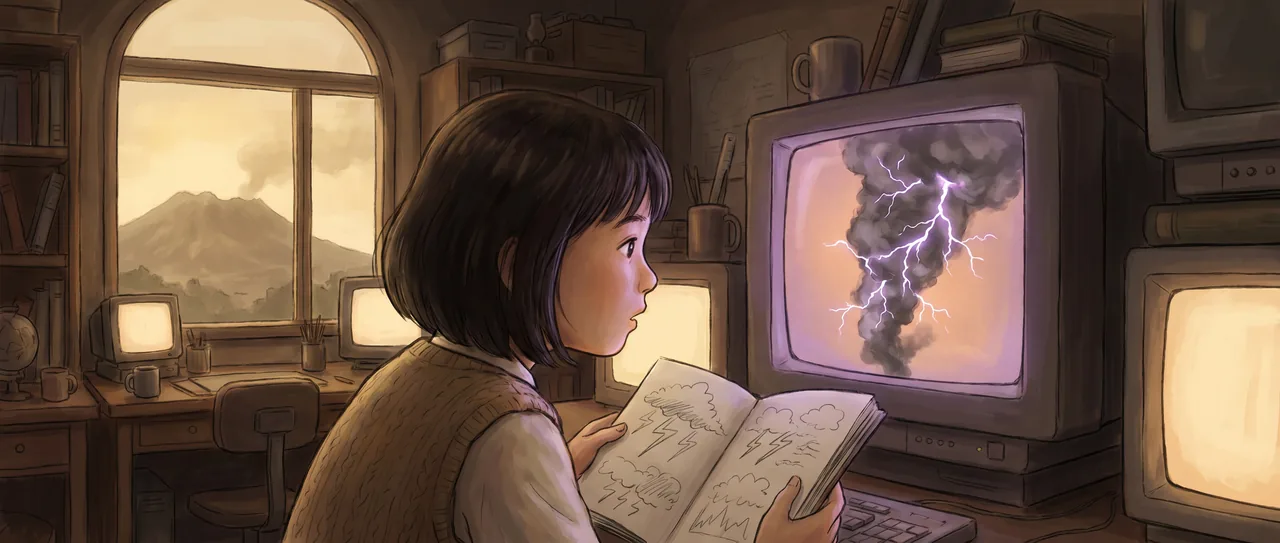
The Storm Inside the Mountain
Mika had been counting eruptions since she was seven.
Not because anyone told her to. Because she couldn't stop. Every time Sakurajima coughed its grey breath into the sky above Kagoshima Bay, she'd press her face to whatever window was nearest and whisper the number. Four hundred and twelve. Four hundred and thirteen. Her classmates had stopped asking why a long time ago.
Now she was eleven, and she was standing inside her mother's volcanological observation station for the first time — not as a visitor, not on a school trip, but as a real assistant for the weekend monitoring shift. Her mother studied seismic signals in the back room. Mika had been given one job: watch the camera feeds pointed at the summit crater and log any visual changes.
She took the job seriously. She had a notebook.
For three hours, nothing happened. The mountain sat under a pale sky, trailing a lazy wisp of steam. Mika sketched the wisp. She noted the time. She sketched it again seven minutes later when it bent east.
Then, at 14:07, the plume punched upward.
It wasn't the biggest eruption she'd ever seen — maybe a three on her personal scale — but on the infrared camera, the column of ash billowed fast and tall, dark as a bruise, climbing what looked like two kilometers in under a minute. Mika logged it. Time, height estimate, color, direction of drift.
And then she saw it.
A fork of light — not above the cloud, not from the sky, but inside the ash column itself. A bright, jagged vein of purple-white that crackled through the plume like a living thing and vanished.
"What," Mika whispered.
She stared at the screen. Another flash. Then three at once, stitching through the dark cloud from the inside, turning it briefly into something that looked like a lantern full of broken glass.
Lightning. But there was no thunderstorm. The sky around the plume was clear.
Mika grabbed her notebook and started drawing the flashes — where in the column they appeared, how long they lasted, whether they branched up or down. She didn't know why she was drawing them. She just knew that something was happening that she didn't understand, and when she didn't understand something, her hands moved before her brain caught up.
Her mother came in twenty minutes later to check the seismic readout and found Mika surrounded by sketches.
"Mom. There's lightning inside the ash."
Her mother glanced at the screen and nodded. "Volcanic lightning. Beautiful today."
"But how? There's no storm."
Her mother smiled the way she did when Mika asked the kind of question that had more than one answer. "The eruption makes its own storm. Think about it. What's inside that column?"
"Ash. Gas. Tiny rock fragments."
"And they're all doing what?"
Mika watched the plume churn. Billions of particles, blasted upward, tumbling, colliding, smashing into each other at enormous speed inside a column of superheated gas. Colliding.
She looked down at her sketches. She'd once rubbed a balloon on her sweater and stuck it to the wall. She'd once shuffled across a carpet in socks and shocked her cousin's ear.
"They're building up charge," she said slowly. "Like — like static. Every time the particles hit each other, they're transferring electrons. Some go positive, some go negative. And when enough charge builds up—"
"It has to go somewhere."
Mika turned back to the screen. Another vein of light split the cloud, and this time she didn't just see it — she understood it. The eruption wasn't just rock and fire. It was a machine that built electricity. The mountain was making its own weather, its own lightning, out of nothing but shattered stone and collision.
Her mother went back to the seismic room. Mika stayed.
She kept sketching. She noticed that the brightest flashes appeared where the plume was densest, where the most collisions would be happening. She noticed that near the top, where the ash spread thin, the lightning faded. She wrote that down. She noticed that a second, smaller burst from the crater ten minutes later produced its own lightning almost immediately — and she noted that too.
By the time the plume drifted east and dimmed to a grey smear, Mika had four pages of sketches and observations. She stared at them. They weren't pretty. They weren't organized. But they were hers, and they were real, and they described something true about the world that most people never bothered to look at closely enough to see.
She thought about the ash particles. Trillions of them, each one tiny and meaningless alone. But together, colliding in the dark interior of a cloud, they built something powerful enough to crack the sky open with light. Something from nothing. Pattern from chaos.
And she thought: the universe does this. It takes tiny, ordinary collisions and turns them into lightning. It doesn't need anyone's permission. It just needs enough particles, enough contact, enough time.
Mika flipped to a clean page in her notebook. She wrote the date. She wrote: *Questions I don't know the answer to yet.*
Underneath, she started a list.
*Does the size of the ash particles change the kind of lightning?*
*Is the charge different at the top of the plume versus the bottom?*
*Could you predict volcanic lightning before it happens if you measured the ash density?*
*What other things in the universe build lightning out of collisions?*
The list grew. Outside, the mountain settled. The bay turned gold with late afternoon light. Somewhere behind her, her mother's instruments scratched their steady seismic heartbeat on paper.
Mika looked at her list. It was already twelve questions long, and each one seemed to open into three more, like branches, like veins of light splitting through dark clouds, reaching and reaching into spaces she couldn't see yet.
She picked up her pen and kept writing.
Read the interactive version, listen to the narration, and earn a gold star →
A science-verified short story for curious kids · Curiosity Land