The Language Beneath
Soli pressed her face against the glass wall of Growing Bay 7 and counted the sea rocket seedlings for the third time. Forty-eight. Twenty-four in Plot A, twenty-four in Plot B. Identical soil, identical light, identical water schedule. The only difference was one that nobody could see yet.
"You're in here again," said Dr. Vasquez from the doorway, not unkindly. She was carrying a tray of nutrient samples toward the lab next door.
"The Plot A leaves are wider," Soli said.
Dr. Vasquez paused. "They're only nine days old, Soli. I doubt there's a visible difference yet."
But Soli had been measuring. Not with the lab calipers — those were for authorized experiments — but with a strip of paper she'd marked into millimeters using the ruler in the education module. She kept the measurements in a small notebook she'd made from recycled printer sheets. Plot A leaves: average width 4.2 mm. Plot B leaves: average width 3.8 mm. It wasn't much. But it was consistent.
The difference was roots.
Plot A held siblings — seedlings all grown from seeds of the same mother plant, Cakile edentula number 6, which Soli had named Ruth. Plot B held strangers — seeds gathered from six different mother plants across the greenhouse collection. Above the soil, all forty-eight seedlings looked almost the same. Green. Small. Ordinary.
Soli suspected that beneath the soil, they were living completely different lives.
She'd read about it in an old ecology paper she'd found in the station's digital library while searching for something else entirely. She'd been looking up whether plants could hear music — they couldn't, not really — and stumbled into a reference about Cakile maritima, the sea rocket. In a 2007 experiment, researchers discovered that sea rockets growing beside siblings kept their root systems restrained and cooperative. But when planted next to strangers, they grew aggressive, competitive roots — sprawling out to claim as much soil and nutrients as possible.
Plants could recognize their family.
Not with eyes. Not with anything like a brain. Something in the root chemistry, the exudates leaking from root tips into the surrounding soil, carried information. Identity. Kinship. And the plants responded.
Soli couldn't stop thinking about it. She'd requested the seedlings through the station's education program, designed the plots, and planted them herself. Dr. Vasquez had approved it as an independent study but warned her not to expect dramatic results.
"Plants are slow storytellers," she'd said.
Soli was good at slow.
On day fourteen, she submitted her request to use the station's micro-imaging scanner. The education board took two days to approve it. On day sixteen, she carefully extracted one seedling from each plot — choosing the median-sized specimen in both cases — sealed them in observation gel, and slid them under the scanner.
Her hands were shaking.
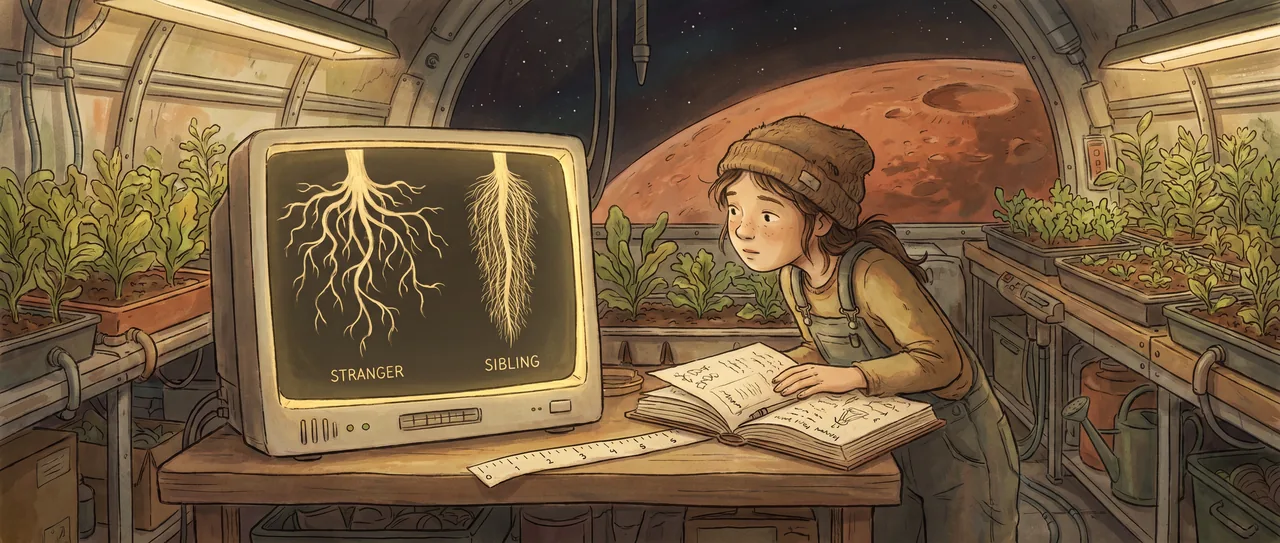
The Plot B stranger's root system appeared first on the display, rendered in pale gold light. It sprawled wide, branching aggressively in every direction, root tips flung out like fingers grasping for territory. It looked almost frantic.
Then Plot A. The sibling.
Soli held her breath.
The roots were shorter. More compact. But they were thicker, healthier, and surrounded by dense webs of root hairs — delicate filaments that increased surface area for absorbing water. The plant hadn't needed to fight. It had grown down instead of out. Deep instead of wide.
They were sharing.
Forty-eight plants that looked identical above the soil were building entirely different worlds beneath it. The siblings had recognized each other through nothing but chemistry — molecules released into darkness — and chosen cooperation. Not because anyone told them to. Because something in their biology already knew.
Soli sat back from the scanner and felt the greenhouse shift around her. Not physically. But the way a room shifts when you suddenly understand that everything in it is doing more than you thought. The ferns along the east wall. The tomato vines spiraling up their stakes. The ancient basil plants that Mrs. Okonkwo had brought from the original colony transport. Every root system on this station was in conversation with the soil around it, sending chemical signals into the dark, and those signals meant something.
She looked at the display again. Two root systems. One grasping outward. One growing deep.
She thought about the station. Three hundred people in a metal ring around Mars. Some of them were born here together. Some arrived on different transports from different continents. And somehow, despite everything, they shared air and water and growing bays and the single most precious thing in space — soil.
Were they siblings, or strangers?
Maybe it didn't have to be biology. Maybe recognition was something you could build.
Soli opened her notebook to a fresh page and wrote: "Question — if stranger plants are exposed to sibling root exudates over time, do they eventually change their root growth pattern? Can strangers learn to share?"
She stared at the question.
Nobody on the station had studied this. She'd checked. The original researchers on Earth had focused on the recognition, not on whether it could be taught. But here, in a greenhouse floating above a rust-colored planet, Soli had forty-six remaining seedlings, a micro-imaging scanner, and the kind of patience that made other kids her age slightly uncomfortable at lunch.
She didn't mind. Some people needed big, fast things — races and competitions and loud answers. Soli needed small, slow things. The width of a leaf. The direction of a root. The almost imperceptible moment when a living thing decides to reach toward another living thing instead of away.
She closed the notebook and looked at the plots through the glass.
"Okay," she whispered to the seedlings. "New experiment."
Beneath the soil, in the warm dark that no one on the station could see, the roots kept growing — carrying messages in a language that Soli was only beginning to learn, that the universe had been speaking long before anyone thought to listen, and that she now understood would take her whole life to translate.
Read the interactive version, listen to the narration, and earn a gold star →
A science-verified short story for curious kids · Curiosity Land