The Girl Who Watched Helium Climb
The other kids had already moved on to the magnet demonstration.
Mara hadn't.
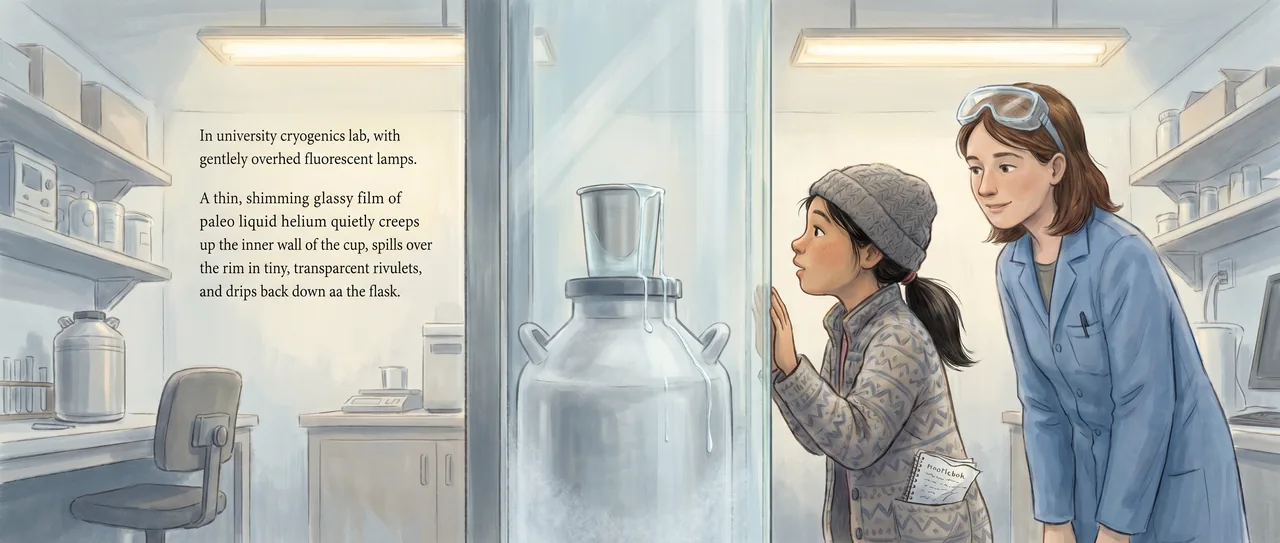
She stood on her toes, pressing her face close to the glass shield around the dewar flask, watching the liquid inside do something that liquid was not supposed to do. It shimmered, pale and almost invisible, like water pretending to be air. But that wasn't the strange part.
The strange part was that it was climbing.
A thin, glassy film of it crept up the inside wall of the metal cup — up and over the rim — and down the outside, where it gathered into drops that fell back into the larger flask below. No pump. No siphon tube. The liquid was just… leaving. Crawling out of its own container like it had somewhere better to be.
"It's not supposed to do that," Mara whispered.
The graduate student supervising the station — a tall woman with safety goggles pushed up on her forehead — glanced over. "Most people just say 'cool' and walk away."
"But it's climbing," Mara said. "Liquid doesn't climb."
"This liquid does."
"Why?"
The graduate student smiled the way people smiled when they were deciding whether to give the real answer or the simple one. Mara hated the simple one. She always had. She was the kid who'd gotten in trouble in third grade for asking why ice was slippery and not accepting "because it's smooth" as an answer. (It wasn't the answer. It turned out to be about pressure and a thin layer of melt, and she'd found that out herself, in the library, on a Tuesday.)
"How much do you know about temperature?" the student asked.
"It's how fast atoms move," Mara said. "The slower they move, the colder it gets. Absolute zero is when they basically stop."
"Good. This is helium-4, cooled to about two degrees above absolute zero. At that temperature, it becomes a superfluid." She pointed at the creeping film. "Zero viscosity. No friction at all. None. It flows without losing any energy, ever."
Mara's brain snagged on that the way a sweater snags on a nail. Zero friction. She turned the idea over. Every liquid she'd ever seen — water, juice, the honey her dad poured too slowly on Sunday mornings — had some resistance, some thickness, some drag. Friction was what made liquids behave. It was why you could fill a glass and the water would stay.
But if a liquid had no friction at all…
"It climbs because nothing's stopping it," Mara said slowly.
The graduate student's eyebrows went up.
"I mean —" Mara's thoughts were moving fast now, faster than she could organize them, the way they always did when she was close to something. "The helium molecules are attracted to the walls of the cup, right? Van der Waals forces. Any liquid is. But normal liquids have viscosity holding them back, so the attraction just makes a tiny meniscus at the edge. But this —" she pointed, finger trembling slightly, "— this has nothing holding it back. The attraction pulls it up and there's no friction to say stop, so it just keeps going. Over the rim. Down the outside. It escapes."
The lab was quiet for a moment. The magnet demonstration hummed in the next room.
"How old are you?" the graduate student asked.
"Eleven."
"That took me until my second year of undergrad."
Mara barely heard her. She was watching the helium again, the impossibly thin film sliding up and over, and something was expanding inside her chest — something huge and a little frightening. Because if this was true — if a liquid could flow with literally zero resistance — then friction wasn't just a nuisance to be reduced, the way her science textbook said. Friction was a wall. Friction was the thing that kept the universe looking ordinary. Take it away and matter did things that looked like magic. Climbed walls. Escaped containers. Flowed forever without slowing down.
What else was being held back by forces so familiar nobody thought to question them?
"Does it ever stop?" she asked. "The flow. If you had a circular channel, would it just go around and around forever?"
"Essentially, yes. They've observed persistent currents in superfluid helium that show no measurable decay. It flows and flows and flows."
Forever. A liquid flowing forever. Mara felt the word rearrange something behind her eyes.
She thought about the creek behind her house, how it slowed in summer and stopped in drought. She thought about her own blood, pushed by a heart that would someday get tired. Everything she'd ever known about flow involved loss — energy bleeding away, motion winding down, things gradually stopping.
But not this. This just kept going.
The other kids came back from the magnet room, noisy and jostling. The tour guide was herding everyone toward the exit. Mara's school group shuffled past, and her friend Priya tugged her sleeve.
"Come on, Mara. Bus."
"One second."
She looked at the helium one more time. The film was still climbing, still spilling over, patient and unhurried and completely impossible and completely real.
"Can I come back?" Mara asked the graduate student.
"We're here every Saturday."
Mara nodded. She pulled a crumpled notebook from her coat pocket — the one she carried everywhere, the one the kids at school called her "weird book" — and wrote two lines:
What else behaves differently at zero resistance? What if friction is hiding the real rules?
She followed Priya toward the bus. Outside, the October air hit her face, and she could feel it now — the molecules of nitrogen and oxygen bumping against her skin, sluggish with their tiny frictions, dragging against each other and the world.
But somewhere in that building behind her, a liquid was climbing out of its cup and falling upward and flowing in circles that would never end, and the universe was so much stranger than it looked, and the questions in her notebook were multiplying, and she was already thinking about Saturday.
Read the interactive version, listen to the narration, and earn a gold star →
A science-verified short story for curious kids · Curiosity Land