The Girl Who Counted Backwards
Maki's mother said she asked too many questions for a ten-year-old. Her grandfather said she asked exactly the right number.
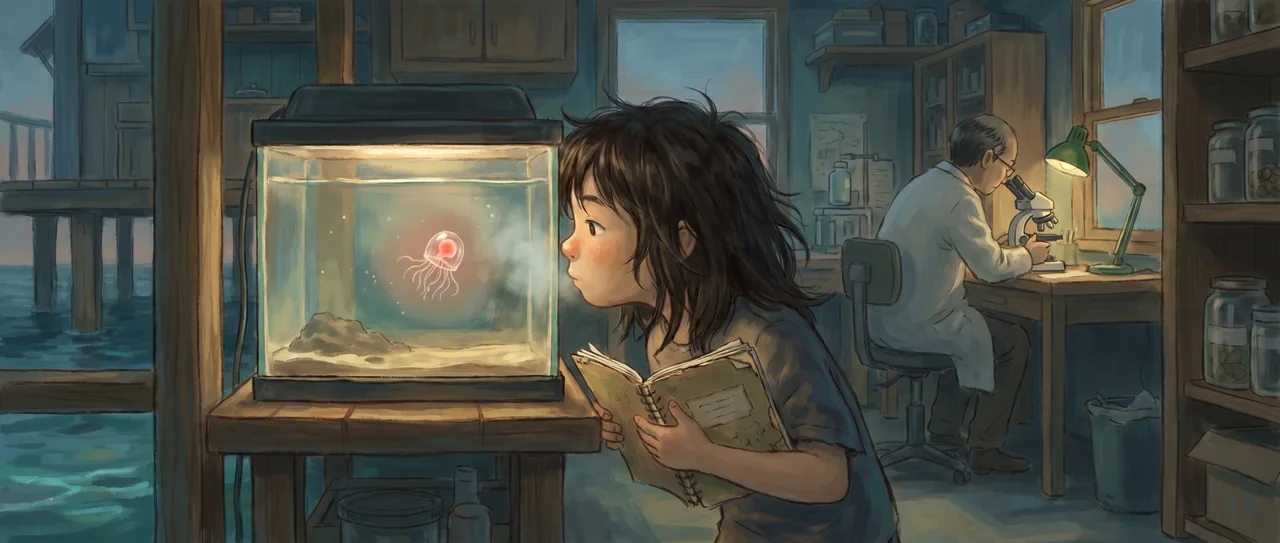
The research station sat on stilts above the tide pools, and Maki visited every Saturday while her mother worked the front desk. The scientists were used to her by now. They let her wander the wet lab as long as she didn't touch the centrifuge or drink from the beakers, which she'd only done once, and it had only been seawater.
Today she stood in front of Tank 7, which was the smallest tank in the lab and also, she had decided, the most important one. Inside, a jellyfish no bigger than her pinky nail drifted in slow circles. It was almost transparent, with a stomach that glowed faintly red, like a tiny heart-shaped lantern.
"You're doing it again," said Dr. Ando, not looking up from his microscope.
"Doing what?"
"Staring at the Turritopsis like it owes you money."
Maki pressed her nose closer to the glass. "It's not the same one."
Dr. Ando looked up. "What?"
"Last week it was bigger. It had its bell fully open, and I counted — it had maybe ninety tentacles. Now look." She pointed. The creature in the tank was smaller, simpler, with fewer tentacles. "Either you switched it, or something happened."
Dr. Ando set down his pipette and walked over. He looked at the tank, then at Maki, then at the tank again. "Nobody switched it."
"Then it shrank."
"Not exactly." He pulled up a stool and sat so they were eye-level with the tank together. "What do you know about how jellyfish grow?"
"They start as polyps. Little tubes stuck to rocks. Then they bud off and become medusae — the floaty bell shapes. That's the adult."
"Right. And for almost every jellyfish species, that's a one-way trip. Polyp to medusa. Young to old. Like you'll grow up and become an adult, and you can't un-grow."
Maki waited. She could feel the question building behind her ribs, the way it always did when something was about to not make sense in the best possible way.
"This one," Dr. Ando said quietly, "goes backwards."
Maki stared at the jellyfish. "Backwards?"
"When it's stressed — injured, starving, sick, old — it can sink to the bottom and revert. Its adult cells transform. They become polyp cells again. It doesn't just heal. It becomes young again. And then it grows up all over."
"So last week it was the adult, and now—"
"Now it's restarting."
Maki's hands gripped the edge of the table. The lab suddenly felt like a much larger room than it had thirty seconds ago. She thought about all the arrows she'd ever seen in biology textbooks, pointing one direction: egg to larva, larva to adult, seed to tree. She'd assumed those arrows were laws, like gravity. But this jellyfish just — turned the arrow around.
"How many times can it do that?" she whispered.
"We don't know. Theoretically? There's no limit. It could cycle forever."
Forever. The word hung in the salt air.
Maki pulled out the battered notebook she carried everywhere — the one her classmates teased her about, the one filled with drawings of tidal currents and questions she hadn't answered yet. She flipped to a blank page and wrote: HOW?
"The process is called transdifferentiation," Dr. Ando said, watching her write. "Its cells change from one specialized type to another. A muscle cell becomes a nerve cell. A nerve cell becomes — whatever's needed. It's like if you could turn a brick wall back into wet clay and rebuild it into something new."
Maki wrote faster. "Do the cells remember what they were?"
Dr. Ando paused. "That," he said, "is a very good question. We're not sure. The DNA is the same. The organism is genetically identical to what it was before. But whether it retains anything — any pattern, any record of having been adult—" He shrugged. "That's what we're trying to find out."
Maki stared at her notebook. She'd written the word MEMORY and circled it three times without realizing.
She thought about it all through lunch. She thought about it while her mother drove them home. She thought about it in the bath, where the water reminded her of the tank, and she held her breath and watched her own fingers wrinkle and wondered if the wrinkling was a tiny, useless version of the same thing — cells responding to the world, reshaping.
At midnight, she turned on her lamp and opened the notebook again.
She'd been drawing the jellyfish's life as a circle — adult, revert, polyp, grow, adult, revert — and something about the shape bothered her. It wasn't really a circle. Each time the jellyfish reverted, it wasn't going back to the same starting point. The ocean around it had changed. The water was different. The bacteria in the tank were different. It was starting over in a world that had moved forward.
So it wasn't a circle. It was a spiral.
She drew it: a loose spiral that kept widening, each loop larger than the last. The jellyfish at the center, getting a new beginning each time, but never the same beginning.
Something about the drawing made her breathing go shallow. She wasn't sure she could explain it yet. But she felt it: the universe had just shown her a living thing that refused the straight line of time. Not by magic. By chemistry. By the patient transformation of one kind of cell into another, over and over, as many times as necessary.
She wrote beneath the spiral: What if forgetting is how it survives? What if starting over IS the memory?
She didn't know if that was right. She didn't know if Dr. Ando would nod or shake his head. But the question felt alive in her chest, warm and restless, like something with tentacles just starting to unfurl.
Maki closed the notebook, turned off the lamp, and lay in the dark, listening to the sea through her open window.
Somewhere out in that black Pacific water, a jellyfish no bigger than a fingernail was dissolving its own adulthood, surrendering every tentacle, every bell, every structure it had built — and beginning again.
And Maki thought: if a creature that small can reinvent itself that completely, what else is possible that we haven't thought to look for?
She did not sleep for a long time. She was too busy beginning.
Read the interactive version, listen to the narration, and earn a gold star →
A science-verified short story for curious kids · Curiosity Land