The Gap Between Stars
Zara kept a notebook of things that came in pairs.
She'd started it in third grade — socks, binary stars, the two halves of a walnut shell. Now, at twelve, the notebook was fat and dog-eared and traveled everywhere with her aboard the Curiosity Ring, the orbital school that circled Earth every ninety-two minutes. Most of the other students thought the notebook was weird. Zara thought the other students weren't paying attention.
Today, Mr. Yuen had drawn a number line on the lightboard that stretched the length of the classroom, from 1 all the way to 200. He'd circled all the prime numbers — 2, 3, 5, 7, 11, 13 — in blue.
"Notice anything?" he asked.
Several hands went up. "They get farther apart," said Kai from the back row.
"Good. As numbers grow, primes become rarer. The gaps between them stretch wider and wider." Mr. Yuen dimmed the lights, and the number line glowed. "Now look more carefully. Some of you might see something else."
Zara was already looking. She'd noticed it before Kai answered. Some of the blue circles came in pairs — primes separated by exactly two. She leaned forward: 3 and 5. Then 5 and 7. Then 11 and 13. Then 17 and 19. She traced the line further — 29 and 31, 41 and 43, 59 and 61.
"Twin primes," she murmured.
"Say that louder, Zara."
She flushed. "Some primes come in pairs. They're only two apart. Like — like they found each other."
Mr. Yuen smiled. "Mathematicians call them twin primes. And here's what's extraordinary: for over two thousand years, nobody has been able to prove whether twin primes ever stop appearing — or whether they go on forever."
The class moved on to other things. Zara did not.
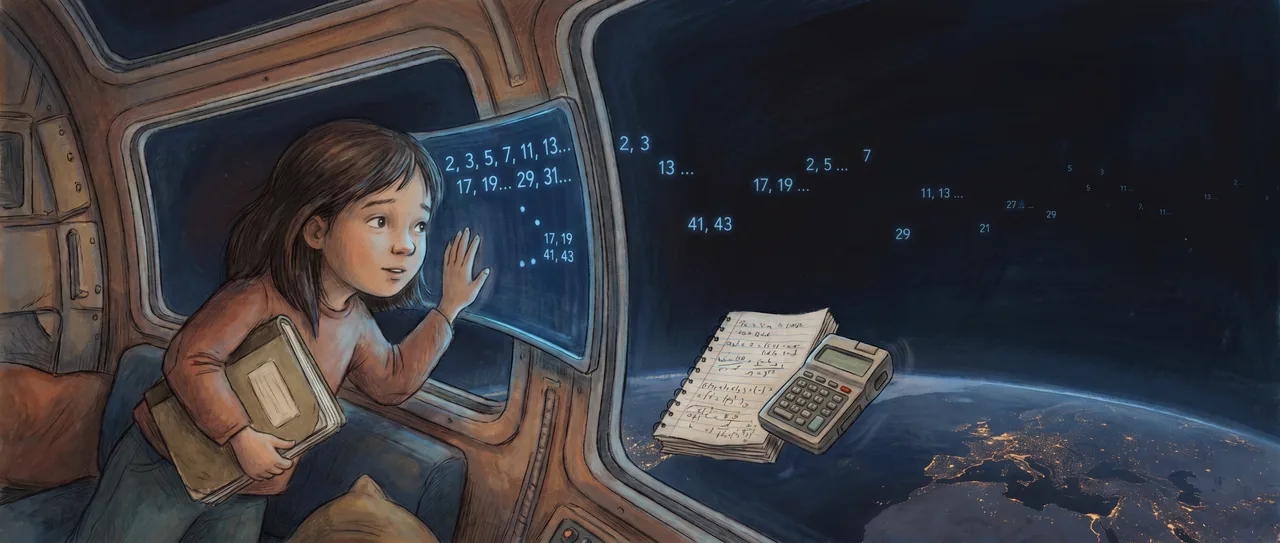
That night, while the station slid over the dark side of Earth, Zara floated in the observation pod with her notebook and the math terminal. She asked the station's AI, Lumen, to show her the primes up to ten thousand.
"Display ready," Lumen said warmly, and the curved window filled with numbers. The primes glowed blue against black, like a field of stars. Zara saw it immediately — the blue lights thinned out as the numbers grew larger, just like Mr. Yuen said. Vast dark stretches with nothing. Hundreds of numbers between one prime and the next.
But then — there. 10,007 and 10,009. A twin pair, blazing together in all that emptiness.
Zara pressed her palm to the glass. "Lumen, show me up to one million."
The display zoomed out. Now the primes were sparse as dust. The darkness between them was enormous. But the twin primes were still there — tiny paired sparks, stubborn, refusing to stop.
"Lumen, what's the largest twin prime pair anyone's found?"
"As of this year, a pair with over three hundred thousand digits each. Found by a distributed computing network."
Three hundred thousand digits. A number so large you couldn't write it down if you used every atom on the station as ink. And somewhere out there in that incomprehensible distance, it had found a companion exactly two steps away.
Zara's throat went tight in a way she couldn't explain.
She thought about what Mr. Yuen had said — primes get lonelier as numbers grow. The gaps stretch. The odds of finding a twin get smaller and smaller. But smaller isn't zero. Every time mathematicians looked further, there they were. Another pair. Close together in all that dark.
She pulled up the sieve of Eratosthenes on the terminal and started running it by hand, crossing out composites the way a Greek mathematician had done two thousand years ago. She went past 200, past where Mr. Yuen's number line had ended. The composites fell away. The primes thinned. At 800, she found 821 and 823. At 1,000, she found 1,049 and 1,051. Each time she thought the twins had finally given up, there was another pair.
She started sketching a graph — the gap between consecutive twin prime pairs on the y-axis, how far along the number line on the x-axis. The gaps grew. They grew unevenly, lurching upward, sometimes falling back. Like a heartbeat that slowed but never stopped.
"Lumen," she said. "Has anyone come close to proving twins go on forever?"
"In 2013, a mathematician named Yitang Zhang proved that there are infinitely many prime pairs with a gap of less than seventy million. Others have since reduced that gap to 246. But no one has reached two. Not yet."
Zara sat with that. Someone had proved that primes keep finding companions within seventy million of each other — forever. And then other people, working together, had squeezed that number down to 246. They were closing in on two. On twins.
But the last step — proving the gap could be exactly two, infinitely often — remained open. A door nobody had walked through.
She looked at her graph again. The gaps between twin pairs grew wild and jagged, like mountain ranges. But they kept coming back down. Every time the line soared up into loneliness, it eventually fell — another twin pair, another moment of closeness.
Zara opened her notebook to a fresh page and wrote:
Things that come in pairs: twin primes. They get rarer but maybe never stop. Nobody knows. Nobody has known for 2,000 years.
She looked out the observation window. Below, Earth's city lights traced glowing lines across the dark continents — paired clusters of brightness separated by ocean and mountain and emptiness. Above, the stars did the same thing. Pairs and gaps. Companions in the dark.
She thought about the kid she used to be, the one who'd started the notebook because she noticed things other people didn't, because she couldn't stop finding connections in a world that seemed full of disconnection. She thought about the mathematicians across centuries who'd stared at this same pattern and wondered the same thing she was wondering right now.
The number line went on forever. The primes thinned. The darkness between them grew vast and cold. And yet.
And yet.
Zara closed her notebook and pressed her forehead to the glass. Somewhere out there, past every number anyone had ever checked, there might be two primes sitting side by side — enormous, ancient, patient — waiting for someone to find them.
She picked up her pencil.
Read the interactive version, listen to the narration, and earn a gold star →
A science-verified short story for curious kids · Curiosity Land