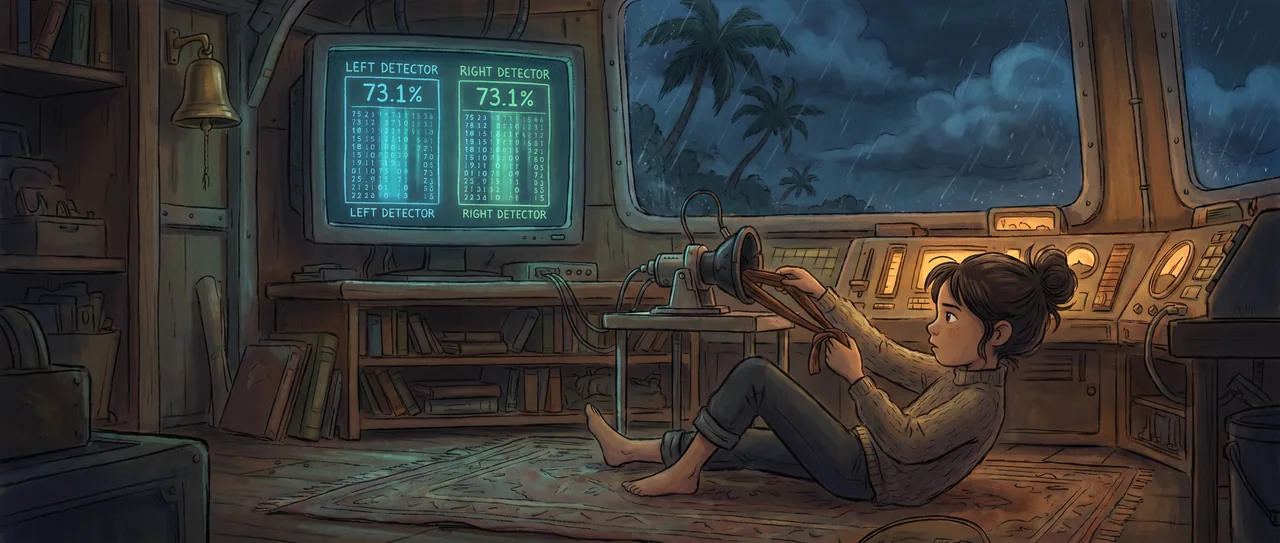
The Other Bell
The bell on Mara's desk had no clapper.
It was a small brass bell, old and green at the edges, and it sat on a ceramic dish next to her mother's monitoring console at the Kailani Relay Station. Mara had flicked it once when she was seven. It made no sound. Her mother said, "The other bell rings," and went back to work, and Mara had been thinking about that sentence ever since.
Four years of thinking. That was Mara's particular problem. She could not stop.
She couldn't stop when Mr. Akamu talked about fractions and she noticed the ceiling tiles were arranged in a pattern that almost repeated but didn't — not quite — and she spent the rest of the period trying to figure out why. She couldn't stop when the other kids at Mākaha School talked about wave-surfing and she wanted to talk about actual waves, the ones that didn't need water, the ones that were just... probability, shivering.
Tonight was her first time at the station after dark. Her mother had finally said yes, because the Taipei link was being calibrated and someone needed to sit with the photon counter while Dr. Yuen ate dinner. "Just watch the numbers," her mother said. "If the coincidence rate drops below sixty percent, press the yellow button and call me."
Mara watched the numbers.
They were beautiful.
Two columns scrolled on the old flat-screen. LEFT DETECTOR. RIGHT DETECTOR. Each column was a waterfall of ones and zeros — random, meaningless on its own, like static. But when she let her eyes go soft and looked at both columns at once, she could see it. They matched. Not every digit, but when one column stuttered, the other stuttered the same way, at the same instant, even though the right detector wasn't here at all. It was in Taipei. Seven thousand kilometers of ocean and atmosphere away.
She pressed her nose closer to the screen. The coincidence rate read 73.2%.
"You're the photons," she whispered to the numbers, and felt silly, and didn't stop. "Somebody made you together. And then they sent you apart. And now when someone looks at one of you..."
She trailed off. She'd read the basics — her mother's bookshelf was not safe from Mara — but reading was one thing. Watching was another. These two streams of light had been born as a single event, split, and flung to opposite ends of an ocean, and they were still... finishing each other's sentences.
Not sending signals. That was the part that made her skull itch. No message traveled between them. No beam of light, no radio wave, nothing crossing the distance. They were simply correlated, the way two halves of a torn photograph are always going to match along the rip, except — except the photograph's pattern wasn't decided until you looked at it.
The coincidence rate flickered: 71.8. 70.4. 68.1.
Mara's hand drifted toward the yellow button. Then she stopped.
She looked at the environmental panel. Temperature: stable. Vibration: low. Humidity: normal. Nothing wrong inside the station. She looked at the alignment laser's readout — the thin red thread that kept the entangled photon pairs aimed at the fiber coupler. It was drifting. Just slightly. A fraction of a degree every few seconds, like someone breathing on it.
She went to the window.
The wind had shifted. She could hear it — the station's western wall was flexing in microgusts from the coming storm, and the vibration was traveling through the floor, up the optical bench legs, into the laser mount. Too subtle for the vibration sensor's threshold. But not too subtle for the photons.
Mara dropped to her knees and crawled under the bench. The mount's three adjustment feet each sat in a small rubber cup — isolation pads. The rear-left cup was cracked. Not broken. Cracked. Just enough to let the building's shiver through.
She pulled the rubber band from her hair, folded it four times, and wedged the pad underneath the cracked cup. Then she held her breath and looked at the screen from the floor, upside down.
68.9. 69.7. 71.0. 72.5. 73.1.
She exhaled.
The numbers kept climbing. She watched them settle, two waterfalls synchronizing again across an ocean, and she felt something open behind her ribs — not understanding exactly, but the shadow of understanding, the shape of a door.
Because here was the thing that made her hands shake: the photons did not know about the ocean. They did not experience distance the way she experienced distance. Whatever connected them was not a bridge across space. It was something deeper than space. As if space were the surface of water and entanglement were something underneath, where there was no such thing as "far away."
The universe was bigger than distance. That was what the numbers were saying.
She sat on the floor of the station and pulled her knees up and listened to the wind and the hum of the cooling system and the tiny clicks of the photon counter, and she thought: there is a texture underneath everything, and it does not care about kilometers, and we can touch it. We built a machine and we are touching it right now.
Her mother found her there twenty minutes later.
"Rate's stable," Mara said. "There was a cracked isolation pad. I fixed it."
Her mother looked at the rubber band, at the numbers, at Mara's face, and did something she didn't usually do during a shift. She sat down on the floor next to her daughter.
"Mom," Mara said. "The other bell. Where is it?"
Her mother was quiet for a moment. "Your grandmother's house. In Busan."
"And when I flicked this one—"
"She called me the next morning. She said the bell on her shelf rang in the middle of the night, once, for no reason." Her mother smiled. "It was probably the wind, or a truck passing. Bells aren't photons, Mara. You can't entangle brass."
"I know," Mara said. "It was a coincidence."
She looked at the screen. The two columns of ones and zeros, waterfalling in silent agreement across seven thousand kilometers of ocean.
"But that's what's strange, right?" she said slowly. "With the photons — it looks like a coincidence too. If you only watch one side, it's just random noise. You'd never know. You can only see the correlation when you compare both streams. So how would we know if there were other kinds of correlations in the world — ones we haven't thought to compare yet?"
Her mother was quiet for a long time.
Mara reached over and placed one finger on the brass bell, lightly, the way you'd touch a sleeping thing you didn't want to wake. She didn't think the bell was magic. She didn't think it was entangled. She thought something more dangerous than either.
She thought: we found one impossible correlation, and we called it quantum mechanics, and it took us a hundred years. What if the universe has others we haven't named?
She didn't flick the bell.
But she didn't move her finger either.
Read the interactive version, listen to the narration, and earn a gold star →
A science-verified short story for curious kids · Curiosity Land