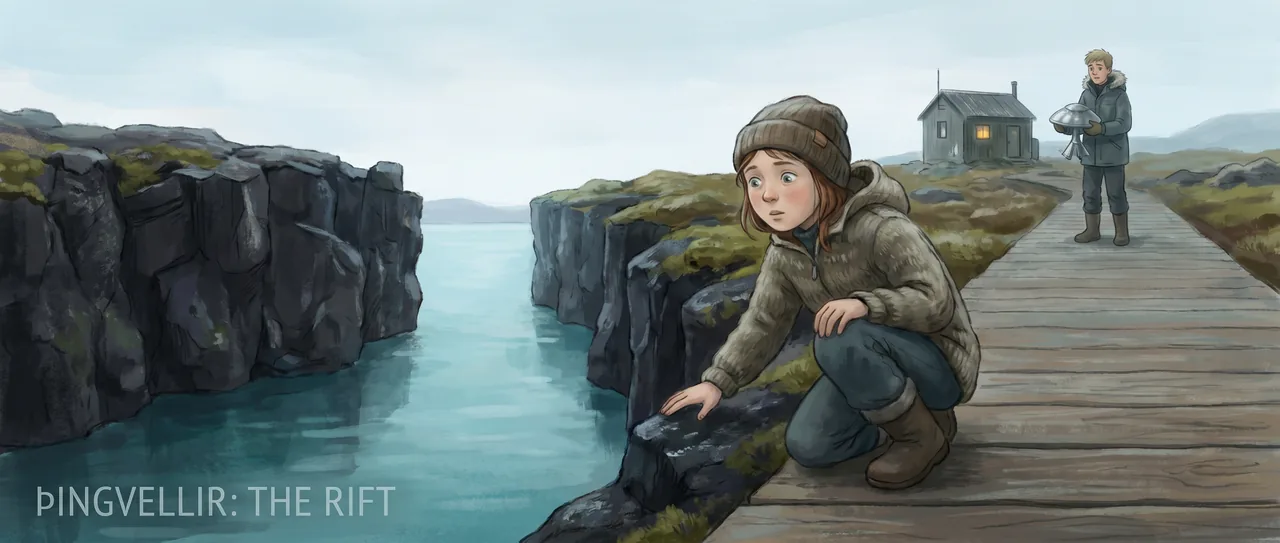
The Distance Between Thumbnails
Rúna pressed her thumbnail against the rock wall and held it there until the cold bit back.
"You're doing it again," said her mother, not looking up from the seismic monitor.
Rúna wasn't doing anything. She was just thinking. The problem was that when Rúna thought, her hands moved, and her mother had decided long ago that moving hands meant fidgeting, and fidgeting meant boredom, and boredom meant trouble.
But Rúna wasn't bored. She was the opposite of bored. She was standing in a crack between two continents.
The Þingvellir rift valley looked like someone had taken the Earth's skin and pulled it apart — gently, patiently, the way you peel apart fresh bread. The research station sat right in the gap, its walls built into the basalt face of what was technically the edge of North America. Across the valley floor, maybe fifty meters away, rose the cliff face of Europe.
Her mother's team had come to calibrate the new GPS sensors along the rift. Rúna had come because it was July and school was out and her father was at a conference in Reykjavík and someone had decided an eleven-year-old could not survive alone in an apartment for three days, which was ridiculous.
"Dr. Þorsteinsdóttir," said Kolbeinn, the youngest researcher, ducking through the station door. He was carrying a sensor pod that looked like a metal mushroom. "The northern array is giving me offset readings. Point-four millimeters since Tuesday."
Rúna's mother frowned. "That's within noise range."
"I know. But it's consistent."
They launched into a conversation about baselines and reference frames that Rúna followed for exactly ninety seconds before the interesting part vanished into acronyms. She slipped outside.
The valley was quiet in the way that only Iceland managed — not silent, because the wind never stopped, but quiet underneath, as if the land itself was holding a long, slow breath. Rúna walked to the edge of the boardwalk and looked down into the Silfra fissure, where glacial water so clear it seemed like air filled the gap between the plates. Divers came from all over the world to swim here, one hand on America, one hand on Europe.
She held up her hands. Looked at her thumbnails.
Two and a half centimeters per year. That was the number she'd read on the flight over, in one of her mother's papers. The North American plate and the Eurasian plate were pulling apart at roughly 2.5 centimeters per year. The paper had called this rate "comparable to the growth of a human fingernail."
Rúna had been turning this over in her head for three days.
She crouched beside the fissure and pressed her right thumbnail against the North American rock face, then stretched her left hand toward Europe. The gap was too wide to reach, of course. Fifty meters. But she held both hands out anyway, feeling the wind thread between her fingers.
Two and a half centimeters. Every year, while she slept through winters and argued through summers and grew out of her shoes, the Atlantic Ocean grew by exactly the width her thumbnail had grown. The same force. The same patience. The same invisibility.
She looked at her nail. There was a tiny white mark near the cuticle where she'd caught it in a door two months ago. That mark had traveled maybe four millimeters since then. Below her feet, in the same span of time, the mantle had pushed these continents apart by the same distance.
The thought hit her like cold water.
The paper on the plane had said Pangaea began breaking apart around 200 million years ago, and the Atlantic started opening maybe 180 million years ago — slowly, unevenly, not all at once. She tried to picture it: a crack forming like the one beneath her feet, widening thumbnail by thumbnail, year after year, for 180 million years. She multiplied in her head — 2.5 centimeters times 180 million — and got 4,500 kilometers. The Atlantic was about 5,000 kilometers wide now. The numbers weren't exact, because the rate hadn't been perfectly constant over all that time, speeding up here, slowing there. But they were close enough to make her grab the railing.
One hundred and eighty million years of fingernail-widths, and you get an ocean.
She stared at the fissure. The rock under her right hand and the rock fifty meters away had once been pressed together, part of the same unbroken land. Dinosaurs had walked across that seam without noticing it.
And every year — every single year for a hundred and eighty million years — the distance had grown by one thumbnail.
She stood up. Her hands were shaking, but not from cold.
"Kolbeinn," she said, walking back into the station so fast she startled him. "Your offset readings. Point-four millimeters since Tuesday. How many days is that?"
"Three days," he said.
"What's 2.5 centimeters divided by 365?"
He blinked. Pulled out his phone. "About 0.068 millimeters per day."
"So in three days, the plates should move about 0.2 millimeters."
"Right, which is why point-four seems —"
"Double," Rúna said. "It's exactly double. What if it's not noise? What if one of your sensors is on a micro-plate fragment that's moving independently?"
Kolbeinn stared at her. Then he looked at her mother.
Her mother was already pulling up the geological survey map. "There's a mapped fracture zone seventeen meters north of sensor four," she said slowly. "We assumed it was inactive."
"Assumed," Kolbeinn repeated.
They went to check. Rúna was not invited, but she followed anyway, and nobody told her to stop. At sensor four, Kolbeinn knelt and ran a ground-penetrating radar unit along the basalt. The screen showed a hairline fracture extending nine meters down.
"It's not inactive," he said quietly. "She's right. This fragment is moving on its own."
Rúna's mother looked at her daughter with an expression Rúna had never seen before — not pride exactly, but recognition, as if she were seeing a familiar landscape from an unexpected angle.
Rúna barely noticed. She was looking at the valley, at the cliffs of two continents drifting apart with the patience of growing fingernails, and she was thinking about what was underneath. Convection currents in the mantle, stone flowing like honey over millions of years, carrying everything — oceans, mountains, entire civilizations — on its back.
She pressed her thumbnail against the rock one more time.
Somewhere deep below, the Earth was already building an ocean that wouldn't have a name for another hundred million years, and Rúna could feel it — not with her hand, but with the part of her mind that had always moved too fast for everyone else, the part that never stopped asking what if, what if, what if — she could feel the whole planet breathing, rearranging itself one fingernail at a time, and she understood that nothing, nothing, was ever quite finished.
Read the interactive version, listen to the narration, and earn a gold star →
A science-verified short story for curious kids · Curiosity Land