Five Parts per Trillion
Everybody said Maren smelled things that weren't there.
She smelled the library books before she opened them — not just old paper, but the specific person who'd read them last. Mrs. Huang smelled like sesame oil and graphite. Mr. Dawson smelled like the copper pipes he fixed all day. She never told anyone this. She'd learned, by age seven, that when you notice things other people don't, it's better to stay quiet.
But the smell that April morning — the one rising off the cracked red earth behind her grandmother's house — that one she couldn't keep to herself.
"Abuela," she said, standing on the back porch. "It smells like rain."
Her grandmother looked up from her weather tablet. Every forecast model showed the same thing: clear skies for eleven more days. The reservoir was down to nineteen percent. The town had been on water restrictions since January.
"There's no rain coming, cariño."
"I know," Maren said. "But I can smell it."
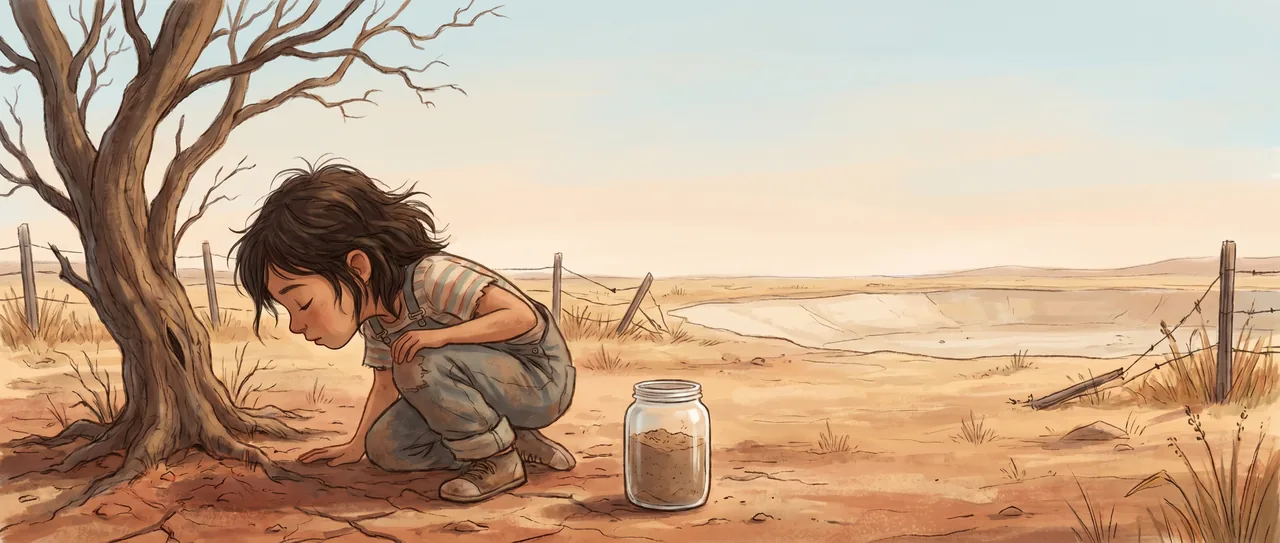
She walked off the porch into the yard. The dirt hadn't seen water in weeks, but there it was — that deep, sweet, earthy smell, the one that normally came in the first seconds after a storm broke the ground open. She crouched and pressed her nose closer to a patch of cracked soil near the old mesquite tree.
Stronger here. Much stronger.
She got a glass jar from the recycling bin, scooped dirt into it, and sealed it. She brought it to school in her backpack, which was a strange thing to carry, but Maren had carried stranger things. A dead beetle in second grade. A frozen soap bubble in a thermos last winter. Her backpack was an archive of questions.
Ms. Kapoor, the science teacher, had an open-lab policy during lunch. You could come in, use the microscopes, run the air sensors, or just sit and read the old journals she kept stacked on the windowsill. Most kids went to the cafeteria. Maren went to Lab 3.
"I brought dirt," Maren announced.
"Excellent," said Ms. Kapoor, without looking up. This was why Maren liked her. She never asked why. She just made room.
Maren unsealed the jar. The smell bloomed immediately — rich, ancient, alive.
"Petrichor," Ms. Kapoor said, breathing it in. Now she looked up. "But it hasn't rained."
"I know."
"Where did you collect this?"
"Under our mesquite. The one with the deep roots."
Ms. Kapoor pulled out a slide kit and helped Maren prepare a wet mount of the soil. Under the microscope, the dirt wasn't just dirt. It was a landscape. Maren adjusted the focus and saw threadlike filaments branching through the grains — pale, delicate, alive.
"What are those?" Maren whispered.
"Streptomyces. Soil bacteria. They're everywhere in healthy ground — they break down dead plants, recycle nutrients. And when conditions change, when moisture shifts, they release a chemical compound called geosmin." Ms. Kapoor wrote the word on the whiteboard. "That's your rain smell."
"But it hasn't rained," Maren said again.
"No. It hasn't."
They stared at each other. Maren looked back through the microscope. The filaments were thick. Dense. More than she'd seen in any soil sample before.
"If they release geosmin when moisture changes..." Maren said slowly, "and I can smell it without rain... does that mean there's moisture coming from somewhere else?"
Ms. Kapoor didn't answer. She just tilted her head the way she did when she wanted Maren to keep going.
Maren thought about the mesquite tree. She'd read that mesquite roots could reach down over a hundred feet. Deeper than most trees. Deeper than the dry surface.
"The roots," Maren said. "The deep roots are pulling water up. And when it reaches the soil near the surface, the bacteria can feel it. They start releasing geosmin because to them — it's raining. From below."
Ms. Kapoor's eyes went wide.
"Hydraulic redistribution," she murmured. "Deep roots pulling groundwater up and releasing it into shallow soil layers at night."
"And the bacteria know before we do," Maren said. "And I can smell what the bacteria know."
She sat back from the microscope. Something was expanding in her chest. She tried to put it into words but the words weren't big enough. Under the dead-looking, cracked, drought-ruined dirt behind her grandmother's house, there was a whole world negotiating with water. Trees pulling it up from deep stone. Bacteria tasting it and singing out a chemical signal. And her nose — her weird, too-sensitive, nobody-else-notices-that nose — was picking up that signal at concentrations so small they were almost imaginary.
"Ms. Kapoor, how sensitive is the human nose to geosmin?"
Ms. Kapoor looked it up. Then she turned the screen toward Maren.
Five parts per trillion.
Maren read it three times. Five molecules out of a trillion. That was like finding five specific grains of sand on an entire beach. Her nose could do that. Every human nose could do that. Evolution had built people to detect this one molecule — this signal from soil bacteria — with a sensitivity that surpassed almost every instrument ever made.
"Why?" Maren breathed. "Why can we smell it so well?"
"Nobody knows for certain," Ms. Kapoor said. "Some scientists think early humans used the smell to find water. That petrichor was a survival signal. That our ancestors who could smell rain — survived."
Maren closed her eyes. She could still smell it on her hands — that ancient, deep, impossible sweetness. She thought about a girl, thousands and thousands of years ago, standing on dry ground in a dry world. A girl who smelled something nobody else noticed. Who followed it. Who found water.
A girl whose trust in her own strange, sharp attention saved everyone who came after her.
That afternoon, Maren brought the soil data to the town water board meeting. She wasn't on the agenda. She stood up during public comment — the youngest person in the room by forty years — and explained, with her jar of dirt and her hand-drawn diagram of mesquite roots, that there was groundwater moving beneath the southeast quarter of town. That the bacteria could prove it. That her nose had found it first.
The hydrologist on the board ordered a survey that week.
But the thing Maren kept thinking about — the thing she was still thinking about when she pressed her face to her pillow that night, the smell of earth still faintly on her skin — wasn't the water.
It was the number.
Five parts per trillion.
What else was the world saying, right now, in signals so faint that no one had thought to listen?
She breathed in deep, and the dark smelled like everything.
Read the interactive version, listen to the narration, and earn a gold star →
A science-verified short story for curious kids · Curiosity Land