The Speed of Now
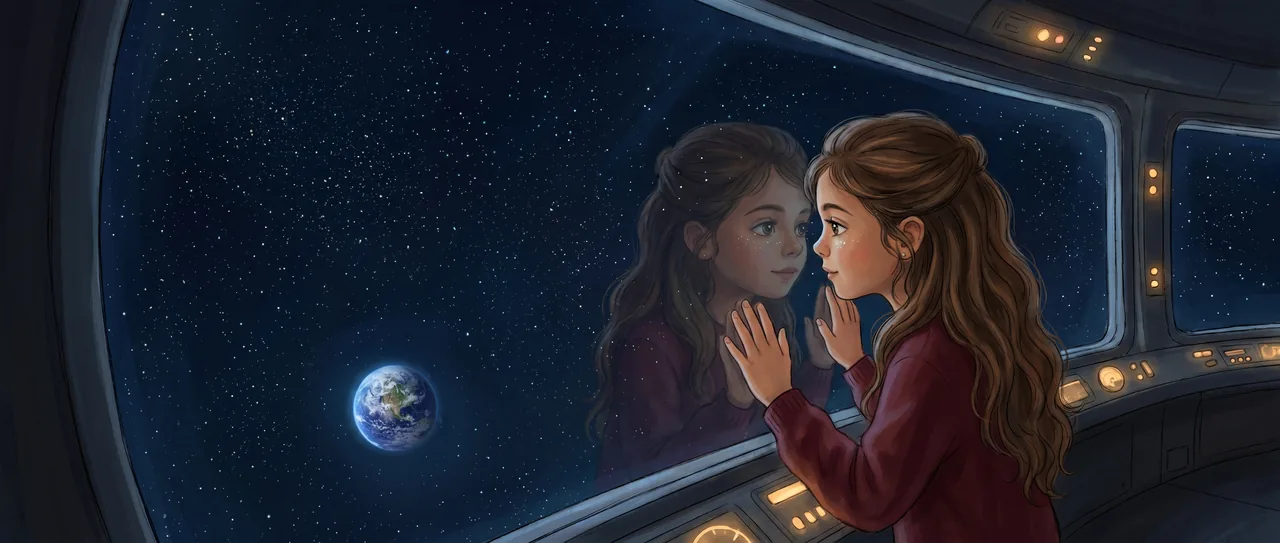
Maya pressed her face against the observation deck's massive window, watching Earth spin below like a blue marble caught in sunlight. The Kepler Station felt so quiet this late in the shift cycle, with most of the crew asleep and only the soft hum of life support systems keeping her company.
"Can't sleep either?" Dr. Chen's voice made Maya turn. The astrophysicist floated toward her, a steaming cup of tea in one hand and a tablet displaying star charts in the other.
"I keep thinking about the light," Maya said, gesturing toward the star field beyond Earth. "Like, that star right there—how old is its light when it gets to my eyes?"
Dr. Chen smiled. "Proxima Centauri? About four years old. But here's something that might keep you awake even longer—want to know what time feels like to the light itself?"
Maya nodded eagerly. Dr. Chen had a way of asking questions that made her brain buzz with possibilities.
"From the photon's perspective," Dr. Chen said, pointing at a distant red giant, "the moment it leaves that star and the moment it hits your retina happen at exactly the same instant. No time passes at all."
Maya blinked. "But that's impossible. Light takes time to travel. That's why we see the past when we look at stars."
"Time from our perspective, yes. But photons experience no time. They exist in an eternal now." Dr. Chen swiped her tablet, showing Maya a simulation of spacetime. "The faster you go, the slower time moves for you. At light speed, time stops completely."
Maya stared at the swirling visualization, her mind racing. "So when I look at that star, I'm seeing light that left millions of years ago, but the photon thinks it just happened?"
"Exactly. Every photon in the universe—from the beginning of time until now—experiences only a single, eternal moment."
Something clicked in Maya's mind, a connection she couldn't quite name yet. She looked back at Earth, then at the ancient starlight streaming past them. "Wait. So all the light in the universe... it's all happening now? From the light's point of view?"
Dr. Chen's eyes widened slightly. "Keep going."
"The light from the cosmic microwave background—the afterglow of the Big Bang that we detect with our instruments—to those photons, they're still being created right now. And the light leaving the Sun, and the light from my flashlight, and the light that will leave dying stars billions of years from now..." Maya's voice grew quiet with wonder. "To the photons, it's all the same moment."
"All the same moment," Dr. Chen repeated softly.
Maya felt something vast opening in her mind, like standing at the edge of an ocean she'd never known existed. "We think the universe has a history, a timeline. But light connects everything to everything else in a single, eternal instant. The entire universe is... simultaneous. From light's perspective, there is no 'before' or 'after.' There's only now."
She pressed her palms against the cool window, watching photons that had traveled unimaginable distances strike the glass and disappear into her eyes. Each one carried the exact moment of its birth—whether from a star that died before Earth formed or from the readout panel blinking beside her.
"So when I look at anything," Maya whispered, "I'm seeing now. Not the past. The photon's now. And that now includes... everything."
Dr. Chen nodded, her expression mix of pride and something deeper. "Maya, you just described one of the most profound aspects of relativity. Most adults struggle with this concept."
But Maya was barely listening. She was thinking about all the light streaming through space at this moment—light from Earth reaching distant worlds, light from those worlds reaching Earth, light carrying information between stars and planets and minds. An invisible web connecting every part of the universe in perpetual simultaneity.
"Dr. Chen," Maya said slowly, "if light experiences everything as one moment, and light is how we see... does that mean the universe is trying to show us that everything is connected? Not just through space, but through time?"
Dr. Chen was quiet for a long moment, looking out at the stars. "That's a beautiful way to think about it. Light as the universe's way of making itself whole."
Maya smiled, but her mind was already racing ahead to new questions. If photons experienced no time, what about other particles at different speeds? What about the information they carried? What about consciousness itself—was it somehow separate from the flow of time, able to receive these timeless messages from across the cosmos?
She looked at her reflection in the window, seeing her face superimposed on the star field beyond. Photons from her warm skin bouncing off the glass, carrying this moment into space. Someday, impossibly far in the future, that light might reach another world, another child looking up at the stars.
And to those photons, that moment would be now too.
"I need to go think about this," Maya said, already moving toward the corridor.
"Maya," Dr. Chen called after her. "What are you thinking about?"
Maya paused at the threshold, her mind spinning with questions she didn't yet know how to ask. "If light makes everything simultaneous... what else might be connected that we haven't figured out yet?"
She hurried down the corridor, leaving Dr. Chen smiling in the starlight, surrounded by photons that had traveled billions of years to reach this moment that, to them, was exactly the same as the moment they began.
Read the interactive version, listen to the narration, and earn a gold star →
A science-verified short story for curious kids · Curiosity Land