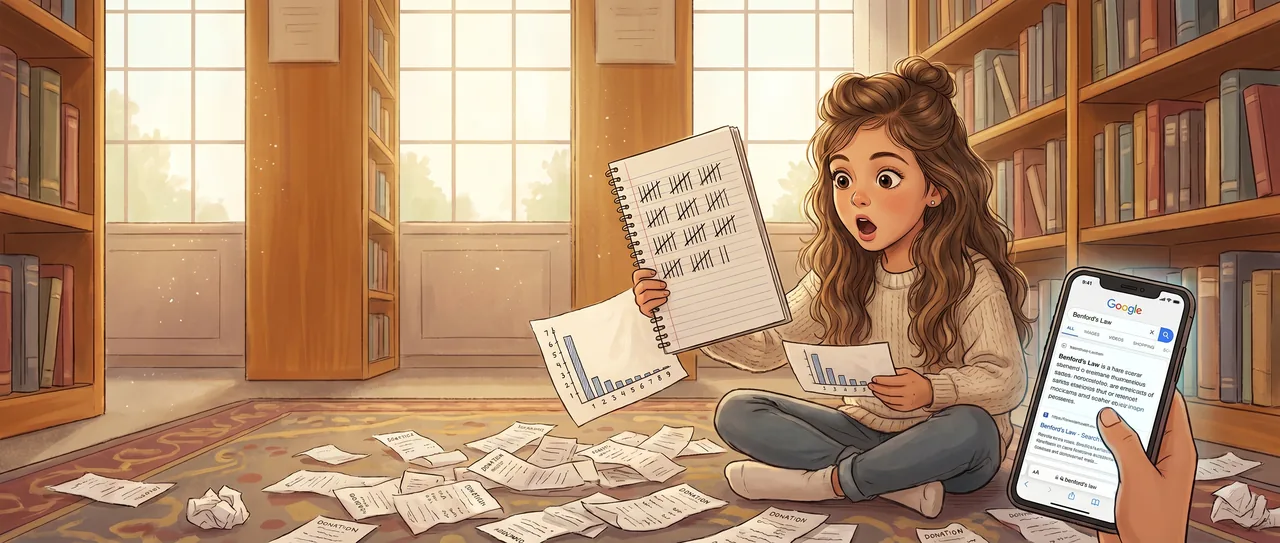
The Pattern Hunter
Maya Chen loved numbers the way other kids loved video games. While her classmates played at recess, she counted things: steps to the water fountain (forty-seven), windows in the school building (thirty-six), even the number of times her teacher said "okay" during math class (usually between twelve and fifteen).
Today, she sat cross-legged on the library carpet, surrounded by donation receipts from the school carnival fundraiser. Mrs. Patterson, the librarian, had asked parent volunteers to help verify the totals, but Maya's mom was running late from work.
"I can start without her," Maya had offered, and Mrs. Patterson had smiled gratefully.
Now Maya stared at hundreds of receipts scattered around her like autumn leaves. Each slip showed how much families had spent: $127.50, $43.89, $256.12. The numbers seemed random, but Maya had learned that random wasn't always what it appeared to be.
She picked up her notebook and started something she'd never tried before: instead of adding the numbers, she began recording just the first digit of each amount.
$127.50 — that was a 1. $43.89 — that was a 4. $256.12 — that was a 2.
After twenty receipts, her list looked like: 1, 4, 2, 1, 3, 8, 1, 5, 2, 1, 7, 1, 9, 2, 1, 4, 1, 3, 1, 6.
Maya frowned. Something felt... wrong. Not wrong-wrong, but pattern-wrong. She'd been expecting the digits 1 through 9 to appear roughly the same number of times, like rolling a die. But 1 kept showing up way more often than the others.
She kept going. Fifty receipts. One hundred. The pattern held.
Maya grabbed a piece of scrap paper and made a quick chart:
Digit 1: appeared 31 times out of 100 Digit 2: appeared 18 times Digit 3: appeared 12 times Digit 4: appeared 9 times Digit 5: appeared 8 times Digit 6: appeared 7 times Digit 7: appeared 6 times Digit 8: appeared 5 times Digit 9: appeared 4 times
"That's impossible," Maya whispered.
But the numbers didn't lie. The digit 1 was appearing almost one-third of the time, while 9 barely showed up at all. It was like the numbers had a secret preference.
Maya's heart started beating faster. This was the feeling she got right before understanding something completely new — like the moment last month when she'd realized why multiplying by zero always gave zero, or when she'd figured out that fractions were just division waiting to happen.
She pulled out her phone and searched "first digit patterns numbers real data."
The first result made her gasp out loud.
"Benford's Law," she read aloud. "In naturally occurring datasets, the digit 1 appears as the leading digit approximately 30.1% of the time, while 9 appears only 4.6% of the time."
Maya stared at her chart. Thirty-one percent. She'd found it without even knowing it existed.
The article explained that this pattern showed up everywhere: in population numbers of cities, lengths of rivers, stock prices, even the numbers in newspaper articles. It worked because of the way real-world data spread out — most things started small and grew, so there were always more numbers beginning with 1 than with 9.
But the most interesting part came at the end: "Benford's Law is used by forensic accountants to detect fraud. When people make up numbers, they tend to distribute the first digits more evenly, not following the natural pattern."
Maya looked back at her receipts with new eyes. The carnival donations followed Benford's Law perfectly. That meant the numbers were real, honest, natural — exactly what they should be.
She thought about what this meant. Every dataset told a story not just through its totals, but through the hidden pattern of how its numbers began. The universe had a secret mathematical signature, and now she could read it.
Maya's mom arrived just as she was finishing her count.
"Sorry I'm late, honey. How did it go?"
"Mom," Maya said, her voice full of wonder, "did you know that the number 1 is magic?"
Her mother laughed. "Magic how?"
Maya held up her notebook, pages covered with tally marks and calculations. "It shows up in the real world way more than it should. And because of that, mathematicians can tell when someone is lying with numbers."
She looked down at the receipts one more time, seeing them completely differently than she had an hour ago. These weren't just random numbers anymore. They were part of something vast and hidden and beautiful — a mathematical law that governed everything from carnival fundraisers to populations of entire countries.
Somewhere out there, Maya realized, forensic accountants were using this same pattern to catch criminals. Scientists were using it to verify research data. And she had discovered it all by herself, just by being curious about something that looked wrong but turned out to be perfectly, mysteriously right.
Maya carefully stacked the receipts into neat piles. Tomorrow, she decided, she was going to test Benford's Law on something else. Maybe the heights of buildings in the city, or the number of books on each library shelf.
After all, if the pattern was everywhere, that meant she could find it everywhere.
And that meant the world was full of secrets just waiting for someone curious enough to count.
Read the interactive version, listen to the narration, and earn a gold star →
A science-verified short story for curious kids · Curiosity Land