The Color Keeper
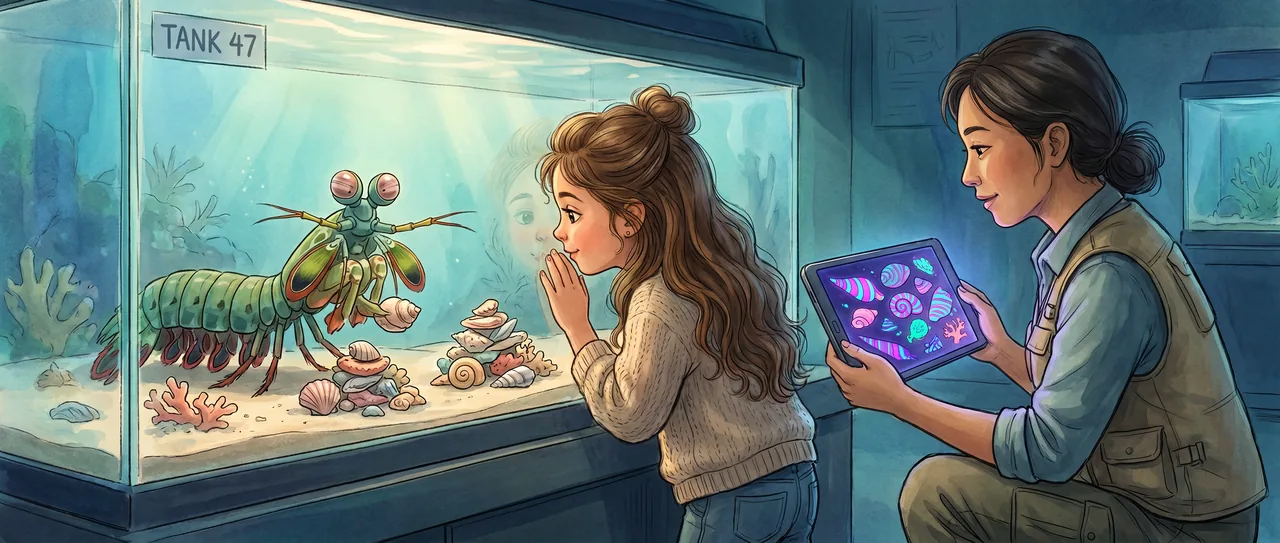
Maya pressed her nose against the glass of Tank 47, watching the mantis shrimp arrange its collection. Most visitors walked past quickly — the creature looked like a weird green lobster with bulging eyes. But Maya had been coming to the Coral Bay Research Station every Saturday for three months, and she'd noticed something nobody else seemed to see.
The mantis shrimp was sorting things. Not randomly scuttling around like the sign said they did. Sorting.
Shells went in one corner. Bits of coral in another. But some shells that looked identical to Maya went into different piles. Some coral pieces that seemed the same color got separated. It was like watching someone organize crayons, except Maya couldn't see the differences the shrimp obviously could.
"Dr. Chen?" Maya found the marine biologist refilling a nearby tank. "Why does the mantis shrimp put shells that look the same into different groups?"
Dr. Chen paused, a bucket of seawater balanced in her hands. "What do you mean?"
Maya led her back to Tank 47. "See? Those two shells look exactly the same to me, but she always puts this one with the pink coral and that one with the white coral."
Dr. Chen set down her bucket and really looked. Her eyebrows went up. "Huh. I've never noticed that pattern before." She pulled out her tablet and started taking notes. "How long have you been watching her?"
"Every Saturday. She's not random at all. She's incredibly organized. But organized by something I can't see."
For the next hour, Dr. Chen observed alongside Maya. Sure enough, the mantis shrimp's behavior had a logic that became clearer the longer they watched. Objects that appeared identical to human eyes were consistently treated differently.
"Maya, I need to show you something." Dr. Chen led her to her office and pulled up a video on her computer. "This is ultraviolet light footage of a coral reef. Watch."
The screen exploded with patterns Maya had never imagined. Corals that looked plain white in normal light blazed with stripes, spirals, and spots in colors that didn't have names. Fish bore markings like neon signs. The reef wasn't the muted brown and green world she thought she knew — it was a festival of impossible colors.
"Mantis shrimp see all of this and more," Dr. Chen explained. "Humans have three types of color receptors in our eyes. Mantis shrimp have sixteen. They can see deep into the ultraviolet range, and they can even detect polarized light — the direction light waves vibrate — which is completely invisible to us. It's like having senses we don't even have a name for."
Maya stared at the video, her mind reeling. "So when I look at those shells..."
"You're seeing maybe five percent of what she's seeing. To her, those 'identical' shells probably look as different as a red crayon and a blue crayon look to you. Some might reflect ultraviolet patterns you'll never see. Others might polarize light differently — and she can tell."
Maya thought about all the times adults had told her she was "too picky" about colors, too focused on tiny details others missed. What if she wasn't being difficult? What if she was just trying to see more?
"Dr. Chen, could we map what she's sorting? Figure out the pattern?"
They spent the afternoon documenting the mantis shrimp's arrangements. Maya sketched the locations of each object while Dr. Chen photographed everything with different light filters — ultraviolet and polarizing filters that revealed hidden dimensions. Slowly, a pattern emerged. Objects placed together shared similar properties under ultraviolet light or matched in how they polarized light, even when they looked completely identical to human eyes.
"Maya, you've discovered something remarkable," Dr. Chen said as they compared the photos. "We knew mantis shrimp could see these wavelengths, but nobody realized they use this vision for organizing their environment. You've documented evidence of complex categorization behavior based on light properties we can't perceive."
As Maya walked home that evening, she kept thinking about the mantis shrimp's world. Somewhere out there were colors she would never see, patterns beyond her imagination. But knowing they existed changed everything. The sunset looked different now — not because it had changed, but because she knew it was only a tiny slice of something infinitely larger.
She thought about the research paper Dr. Chen said they could write together. About the other kids at school who noticed things others missed, who asked questions that made teachers sigh. Maybe they weren't weird. Maybe they were just trying to see more of what was actually there.
The next Saturday, Maya brought her little brother to the aquarium. "Look," she said, pointing to Tank 47. "Watch how she organizes everything. Really watch."
"They all look the same to me," he said after a few minutes.
"That's exactly what makes it interesting," Maya replied. "She can see something we can't. But we can figure out what it is."
As they watched together, Maya wondered what other invisible worlds surrounded them. What patterns existed in polarized light bouncing off every surface around her? What ultraviolet signals were flowers broadcasting to bees that she'd never notice? What would she discover next?
The mantis shrimp picked up another shell, examined it with her alien eyes, and placed it carefully in its proper pile — a pile organized by rules written in wavelengths and vibrations of light Maya was only beginning to understand.
Read the interactive version, listen to the narration, and earn a gold star →
A science-verified short story for curious kids · Curiosity Land