The Cloud That Holds Mountains
Maya pressed her nose against the triple-paned window, watching the supply plane descend through Antarctica's pale sky, its skis kissing the ice runway in a plume of white. In three hours, her parents would load their atmospheric chemistry equipment and fly back to McMurdo, then home. In three hours, she'd be alone at Pinnacle Station with just Dr. Chen and the monthly supply drops.
She wasn't supposed to be here at all. The original plan had her staying with her aunt in Phoenix while her parents finished their winter research season studying ozone chemistry in the polar stratosphere. But when Aunt Sarah broke her leg, and no other arrangements could be made, Maya found herself the youngest person ever to spend a full Antarctic winter at the remote inland outpost.
"Nervous?" Dr. Chen appeared beside her, carrying a steaming mug of hot chocolate.
Maya shrugged. "A little. Mom keeps worrying about the heating system."
"Your mother's a brilliant scientist, but she worries too much." Dr. Chen smiled. "Want to see why she doesn't need to?"
He led Maya through the station's corridors to a storage bay she'd never entered. The walls were lined with panels that looked like frozen smoke — translucent, ghostly blue, almost invisible.
"Touch one," Dr. Chen said.
Maya reached out cautiously. Her fingers met something solid, but it felt like touching crystallized air. "What is it?"
"Aerogel. The most amazing insulator ever created. These panels are what keep us comfortable out here."
Maya ran her palm across the surface. "It's so... light. Like it's barely there."
"Ninety-nine point eight percent air," Dr. Chen said. "But watch this." He picked up a small sample from his workbench and placed it between two metal plates. Then he stacked books on top — one, two, five, ten heavy technical manuals.
The aerogel, thin as paper, didn't budge.
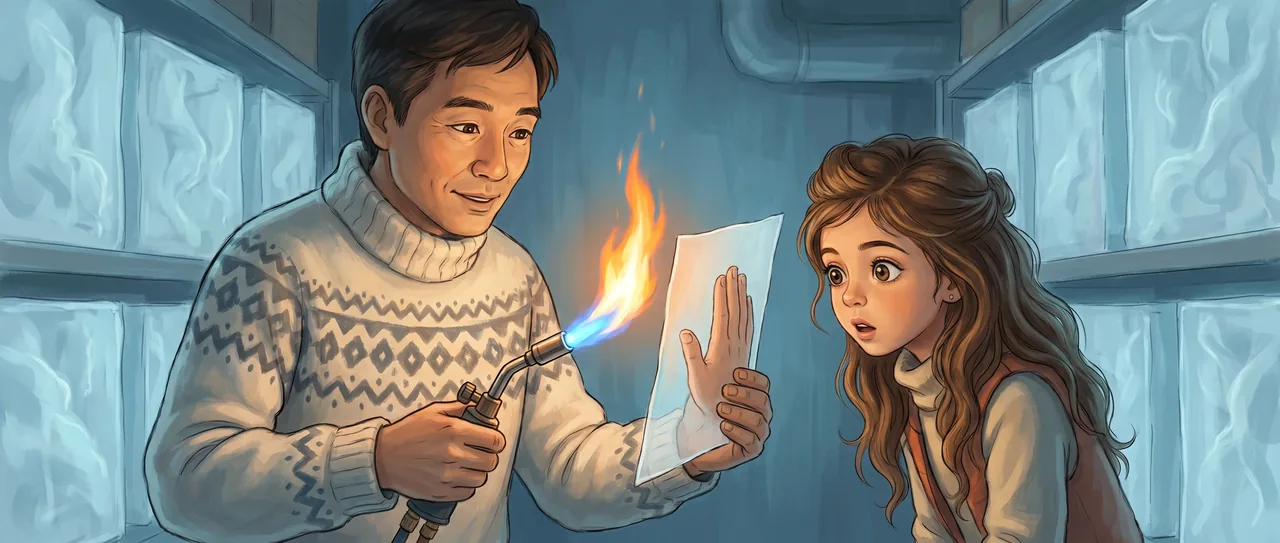
"It can support thousands of times its own weight," Dr. Chen explained. "And here's the really incredible part." He removed the books and held a blowtorch to one side of the aerogel sample while placing his hand on the other side. The flame roared orange and blue, but after thirty seconds, he was still holding his hand comfortably against the cool surface.
"The heat can't get through," Maya whispered.
"The Antarctic interior gets down to nearly negative ninety degrees Celsius in winter. Without these panels, we'd burn through our fuel reserves in weeks trying to keep warm. But with them..." He gestured around the warm, comfortable station. "We barely need our backup heaters."
Maya stared at the aerogel with new eyes. "So it's like... solid air that's stronger than steel and blocks heat better than anything else?"
"Pretty much. Scientists figured out how to take gel — you know, like hair gel — and replace all the liquid with gas, atom by atom, without changing the structure."
That evening, after her parents' plane disappeared into the white horizon, Maya found herself back in the storage bay. She'd brought her tablet and was reading everything she could find about aerogel. The manufacturing process. The different types. The applications across industry and exploration.
"Can't sleep?" Dr. Chen found her there at midnight — though midnight looked the same as noon now, the sun long gone for the winter.
"I keep thinking about it," Maya said. "How do you replace liquid with air without everything collapsing?"
"Supercritical drying. You heat and pressurize the gel until the boundary between liquid and gas disappears. Then you can remove the liquid phase without the structure knowing it's gone."
Maya looked up from her tablet. "So you trick it?"
"In a way, yes."
She spent the next week diving deeper. She learned about silica networks, about how NASA had used aerogel to capture comet dust on the Stardust mission, about its potential in future spacecraft and Mars habitat designs. But what fascinated her most was how something so close to nothing could be so incredibly strong.
Two weeks into her stay, the heating system actually did malfunction — a sensor failure that shut down the backup generators. Maya woke to frost on her breath and Dr. Chen frantically working on the repair.
"How long do we have?" she asked.
"With the aerogel insulation? We've got at least eighteen hours before the interior temperature drops to anything dangerous. Plenty of time to fix this."
Maya watched him work, then wandered back to the storage bay. She pressed her hand against the aerogel panels, feeling their impossible lightness holding back the killing cold of the polar night. These ghostly, nearly invisible sheets were the reason the station survived at all.
She thought about Earth's atmosphere — how even here, at the bottom of the world, there was still air, still pressure, still a planet wrapping itself around them. But humans had learned to push further, to build solid air that could stand against the harshest environments imaginable. And if aerogel could make Antarctica habitable, what could it do on the Moon? On Mars? In the vacuum between stars?
When the heating came back online three hours later, Maya was still in the storage bay, reading about aerogel's proposed use in Mars habitats, in lunar construction, in deep-space exploration. Each application opened new questions. What other materials could be made mostly from nothing? How much stronger could they get? What would buildings look like if you could make walls from crystallized air?
Dr. Chen found her there as the station lights brightened for the artificial dawn cycle.
"You know," he said, "there's a materials science program at the university where your parents work. They're always looking for curious students."
Maya looked up from her tablet, eyes bright. "Do you think... do you think someone could make aerogel that's even more air than ninety-nine point eight percent?"
"I don't know," Dr. Chen said. "But I think you're exactly the kind of person who might figure it out."
Maya turned back to the nearly invisible panels holding back the cold of a continent where no human was ever meant to live, her mind already racing toward possibilities she didn't yet have names for.
Read the interactive version, listen to the narration, and earn a gold star →
A science-verified short story for curious kids · Curiosity Land